
More than a blog. It’s a practice.
What are the Whispers and Echoes?
In a world that moves fast and measures everything, these gentle reminders invite you to pause. They point you inward — toward what truly matters, what can't be quantified, what calls you home to wholeness.
Visit here each weekday to read the latest whisper or conveniently receive them in your email inbox with a complimentary subscription. You can subscribe here. You can invite friends to join in this practice by sharing this link with them: JohnBlumberg.com/NEXT
A Whisper of Integrity
Connection isn’t about losing what is within you. It is about discovering what is within others.
A Whisper of Integrity
Integrity might ask with compassion … Who has become the author of your fears?
A Whisper of Wholeness
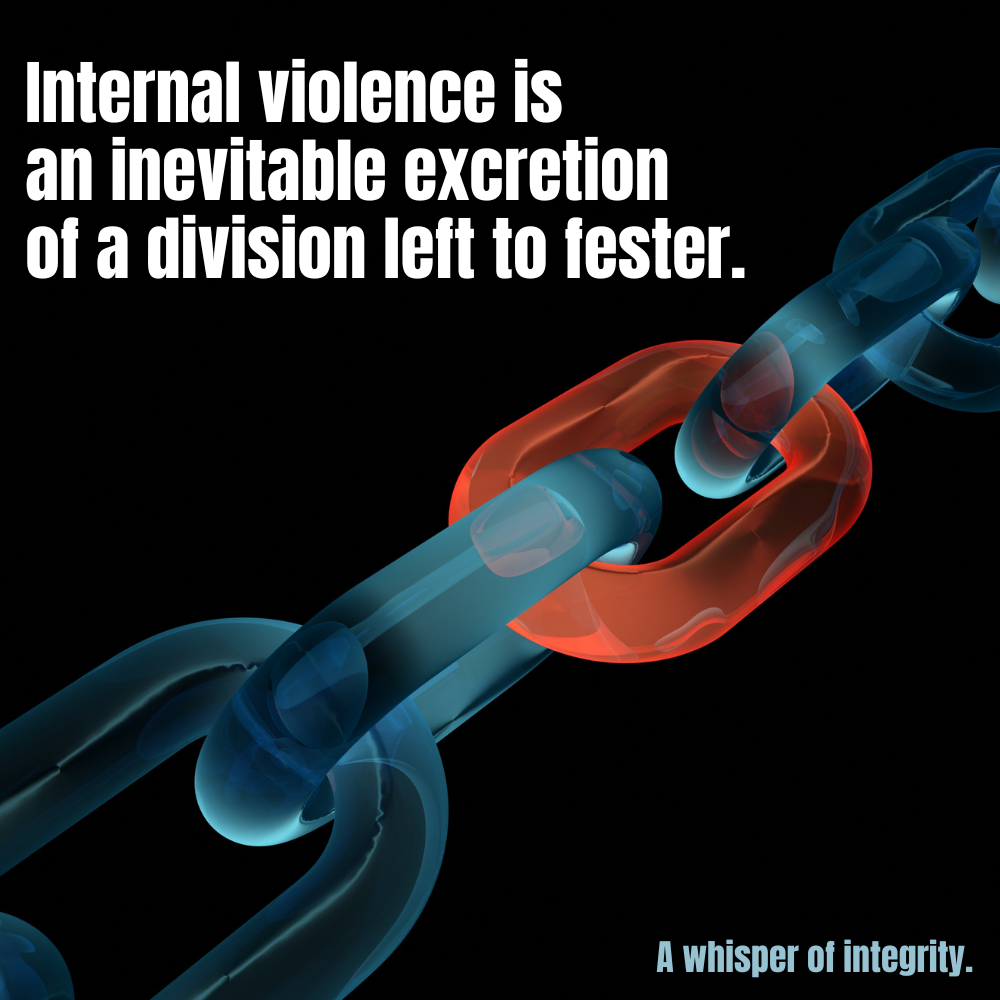
Internal violence is an inevitable excretion of a division left to fester.
Internal violence is an inevitable excretion of a division left to fester.
I can still picture the tweezers my mom kept for splinters. The gentle pressure she applied around the spot. “Sit still,” she would remind me. Then carefully, slowly and intentionally, she removed what didn’t belong. I never hid a splinter from her. I knew she would lovingly take care of it. Years later, on the road, it was a different story. Not hidden. Just postponed. I’ll get to it tonight at the hotel. And if the tweezers weren’t in my attaché case, a safety pin would have to do. Or whatever else had gathered in my luggage along the trail. Usually making it worse.
Most of the splinters we carry now aren’t in our fingers. An unspoken hurt. A conversation we keep putting off. A part of ourselves we’ve set aside for later. We aren’t hiding them. We’re just too busy for them. Yet division never stays small. Left alone, it widens and then deepens … between us and within us. The surface closes over, and what doesn’t belong begins to ache. Eventually, it finds its way out. A sharp word aimed at someone who had nothing to do with it. Wounded … and wounding. Inevitable. Maybe that tender ache isn’t the enemy, though. Maybe it’s simply wholeness, refusing to allow what doesn’t belong.
For further reflection
What small thing have I been too busy to tend … that is quietly beginning to ache?

A Whisper of Integrity
Values become decorations when we admire them more than we allow them to shape us.

A Whisper of Wholeness
Labels are sticky business ... no matter if you are applying or wearing them. They can get you both really stuck and drifting away from integrity ... at the same time.
Labels are sticky business ... no matter if you are applying or wearing them. They can get you both really stuck and drifting away from integrity ... at the same time.
You know the feeling. A price tag on a gift you’re about to wrap. You pick at the corner with a fingernail. It tears. Half comes off and half stays behind, along with that gummy film that grabs every bit of lint in the room. In the most inconvenient place on the gift. At the most inconvenient time. You scrub. You scrape. It just gets messier. Labels are like that. Some are handed to us early. The shy one. The difficult one. The responsible one. Others we apply ourselves, to people we’ve barely met, in the space of a single glance. It only takes a second. Yet removing one can take years … and even then, the residue can linger.
Here is what makes a label so sticky. It names one part yet applies it to the whole. And once it’s on, it keeps speaking. Quietly. The shy one holds back a little more. The difficult one stops expecting to be heard. Without noticing, we begin living toward the label instead of from our core. Stuck to its message … while drifting from who we truly are. All at the same time. And it’s no different when we’re the ones applying them. Each encounter confirms the label we gave. Each confirmation leaves another layer of judgment. Stuck seeing only the label … while drifting further from the person standing right in front of us. And from ourselves. Maybe the invitation isn’t to scrape harder. Maybe it’s simply to notice the label is there and then look again for what it has been covering all along. Wholeness. Still waiting to be discovered.
For further reflection
What is one label I have worn, or applied, for so long that I’ve stopped noticing it’s even there?
A Whisper of Integrity
The awe and wonder of integrity await inside our most unanswerable questions.
A Whisper of Wholeness
When I hold-on tightly to my need to be right, I will diminish the potential of ever experiencing my opportunity to be healed.
When I hold-on tightly to my need to be right, I will diminish the potential of ever experiencing my opportunity to be healed.
Fifty-five minutes of every hour. Face down. For two weeks. The days became long, yet that is what healing was asking of me after surgery to repair a detached retina. Vision returns slowly as a retina heals. Painfully slow. And with each passing hour, I just wanted it to be right. Right then. Right in the way I had pictured it. Face down was hardest in the day. Years later, it would all happen again. Yet, not in the same way, as I thought not again! This time it was face up where I learned the night has its own hard hours. Yet both got easier the moment I stopped asking everything to be right.
Most of us carry a quiet belief that if we could just rearrange things, they would finally be right. A different conversation. A different season. A different posture. Every arrangement has its own hard hours. Wanting it to be right doesn't take the first pain away. It adds a second one on top of it. The resistance. The gripping. Missing the very hour where healing happens. It doesn't wait for us in the future we keep wishing for. It only meets us in the hour we are actually in. Healing can't be gripped. It can only be received … and then experienced. Somewhere along the way, something shifts. Nothing is right yet … and somehow, you are all right.
For further reflection
What is one thing in my life I keep asking to be right … and what might begin to heal if I let it be what it is?
A Whisper of Integrity
Fragmentation is not the absence of integrity. It is losing sight of the wholeness that has never left.
A Whisper of Wholeness
One can go much further by going nowhere and having deep meaning than by going everywhere with no meaning at all.
One can go much further by going nowhere and having deep meaning than by going everywhere with no meaning at all.
Just get me to Friday. I can't count how many times I've said it. Sometimes about a hard week, but just as often about a good one. Get me through this meeting. Past this deadline. On to the next thing. And when Friday finally comes, some part of me is already leaning toward Monday. We rarely notice how much of life we spend standing in the next moment instead of this one. Even vacations get organized into itineraries — seven cities in ten days, every hour accounted for, a phone full of photos of places we never really were. We go everywhere. We cover enormous ground. And somehow we arrive home having been almost nowhere at all.
Years ago, I committed to walking the same prairie path near my home several times a week. Each walk the same limestone trail. The same long stretch of fields filled with what most people would call weeds in their own yard. For weeks it felt like going nowhere, and in a way, in the routine of it all … it was. Every time, I ended up right back where I started. Then one August afternoon, somewhere along a walk I'd taken so many times, I noticed the "weeds" had become a bouquet. Wildflowers were boasting everywhere I looked. They had likely been blooming for weeks. I simply hadn't been present to see them. Not really present. Instead, I had been walking toward the finish line. That prairie has taken me further than most of my travels ever have. Not because it offered more, but because it was quietly waiting for me to stop living ahead of it. Maybe going nowhere was never the problem. It's just the way being now-here seems to a mind in a hurry.
For further reflection
What moment am I trying to get through right now that might be asking me simply to be in it?

A Whisper of Integrity
Humility is like oxygen to the lungs of integrity. Where might I be holding my breath?

A Whisper of Wholeness
Integrity guides with gentle grace. Not harsh judgment.
Integrity guides with gentle grace. Not harsh judgment.
Picture a river after a heavy spring rain. The current runs fast and strong, and in the middle of it you are clinging to a rock with everything you have. Knuckles white. Arms burning. From the inside, the river feels like the enemy — relentless, trying to tear you loose. But the river isn't punishing you. It's simply moving toward everything waiting downstream. The pain isn't coming from the current. It's coming from the grip. We tend to imagine integrity as the harsh one. The stern inner voice keeping score. The judge who notices every way we've fallen short. So we brace against it, gripping whatever feels solid. A position, a habit, an old version of ourselves — and call the ache proof that integrity is hard. Demanding.
Yet integrity doesn't sound like that. It never has. That harsh voice is usually something else wearing integrity's clothes. The ego, keeping its ledger and demanding a performance. Integrity guides. It walks beside you. It points toward what's ahead without ever shoving you there. And its gentleness isn't weakness or permission. It's strength is patient enough to be trusted. Harshness only tightens the hands. Fear grips harder. Shame clings to the rock. The only thing that has ever loosened my fingers is a voice gentle enough to make letting go feel safe. You cannot be shamed into wholeness. You can only be guided there. Grace doesn't calm the river. It reminds you that you were never meant to fight it — and that there is more waiting. Just not here. Downstream where integrity takes you.
For further reflection
What am I clinging to right now because a harsh voice told me to hold on — and what might a gentler voice be inviting me to release?
A Whisper of Integrity
To recall your connection to the greater whole, remember … nothing living carries its own beginning.
A Whisper of Wholeness
Integrity isn't about feeling good. It is about being bothered by what isn't good for the greater whole.
Integrity isn't about feeling good. It is about being bothered by what isn't good for the greater whole.
We've quietly made integrity into a way to feel good about ourselves. Something to perform well enough or comply-with fully enough. We can look in the mirror and feel settled. Proud, even. And there's nothing wrong with feeling good. Until feeling good becomes the measure. Because by that measure, real integrity often fails. Integrity often leaves you feeling unsettled. It leaves you bothered. It's an outcome no one else has questioned that somehow won't let you rest. The arrangement everyone found acceptable that quietly keeps you up at night. We assume the discomfort means something is wrong with us. But what if that bothered feeling was never the problem? What if it's the alarm doing exactly what it was made to do?
Think of physical pain for a moment. We spend our lives trying to avoid it, and understandably so. But pain is one of the body's most loving gifts. The hand yanked back from the stove. The stone you can't ignore in your shoe. Pain isn't cruelty. It's the body refusing to let you harm what it loves. The people who cannot feel pain don't live in peace. They live in danger, wounding themselves without ever first knowing. And I've come to believe integrity works the very same way. That bother you feel when something isn't good for the whole — your family, your team, your community, the people not even in the room — isn't a malfunction. It's the nerve that still works. It's the part of you that hasn't gone numb to the fragmentation others have stopped noticing. Feeling good would be easier. Numbness always is. But numbness isn't peace. It's disconnection wearing a costume of peace. Maybe the bother was never the enemy of goodness. Maybe it was goodness — aching quietly to restore what it can still feel coming apart.
For further reflection
What have I been trying to soothe away that might actually be integrity — aching to restore something that isn't yet whole?

A Whisper of Integrity
Mass thinking can feel like the safety of belonging while quietly outsourcing our own discernment.

A Whisper of Wholeness
Change is the inevitable energy that keeps your integrity from finding its identity in an outdated story.
Change is the inevitable energy that keeps your integrity from finding its identity in an outdated story.
Hold a kaleidoscope to the light and something quietly astonishing happens. The same small pieces of glass — nothing added, nothing taken away — form a pattern so beautiful you want to keep it forever. So you stop turning. You hold it perfectly still, determined to preserve the very thing that moved you. And in that instant, you close the door to all else that is possible. All else that is left to learn. All else that continues to transform you beyond a present experience. A kaleidoscope held-still isn't a kaleidoscope anymore. It's just a tube with some colored glass stuck at the bottom. The beauty was never in the pattern. It was in the turning. This is the tender trap we fall into with our own integrity. We meet it once in a moment that is real, luminous, and true — in some particular season, in one particular form. And we try to hold that encounter still. We build a story around it: this is who I am, this is what my integrity looks like. The story was true. Then. But the light keeps moving, and we're still clutching a pattern which reality has continued past.
Here's the irony we rarely realize: the clutching is the drift. We think staying the same is how we stay true. But change is inevitable. It's the very energy of being alive — and when everything around us keeps turning while we refuse to, our fixed position slowly stops meaning what it meant when we took it. We don’t move, and somehow we drift anyway. I've caught myself defending an old version of who I was, mistaking the defense for integrity, when really I was just trying to keep my kaleidoscope from turning. Keeping things comfortable and familiar. The old story deserves gratitude. It showed me something real. But integrity was never meant to be a museum constructed around a single beautiful moment. It's a living essence of transformation that wants to keep turning toward the next formation of beauty. Change doesn't threaten your integrity. It's what keeps it from quietly turning to stone.
For further reflection
What story about myself have I been holding perfectly still? What new beauty might be waiting inside if I let my kaleidoscope turn again?
A Whisper of Integrity
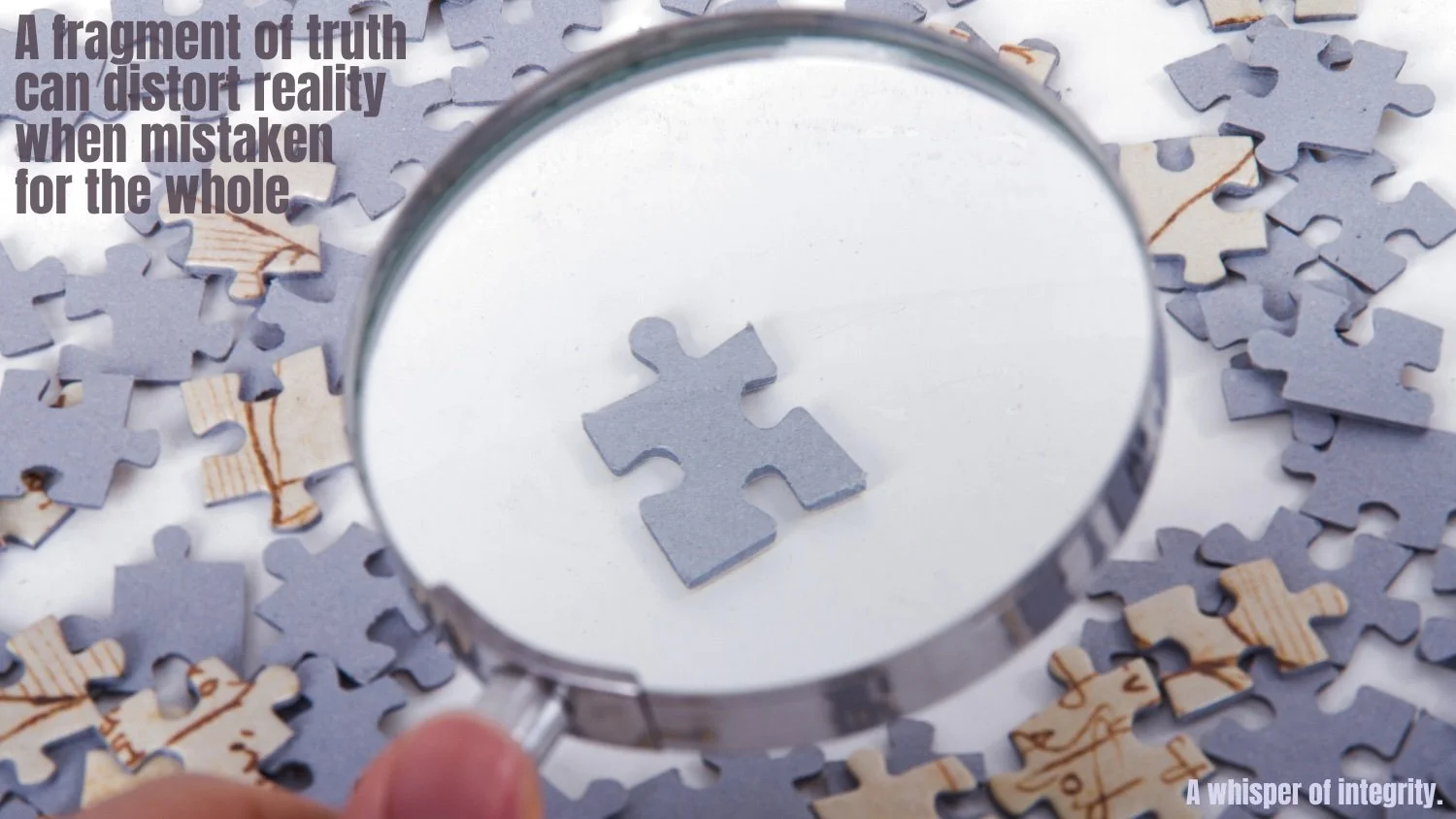
A fragment of truth can distort reality when mistaken for the whole.
A Whisper of Wholeness
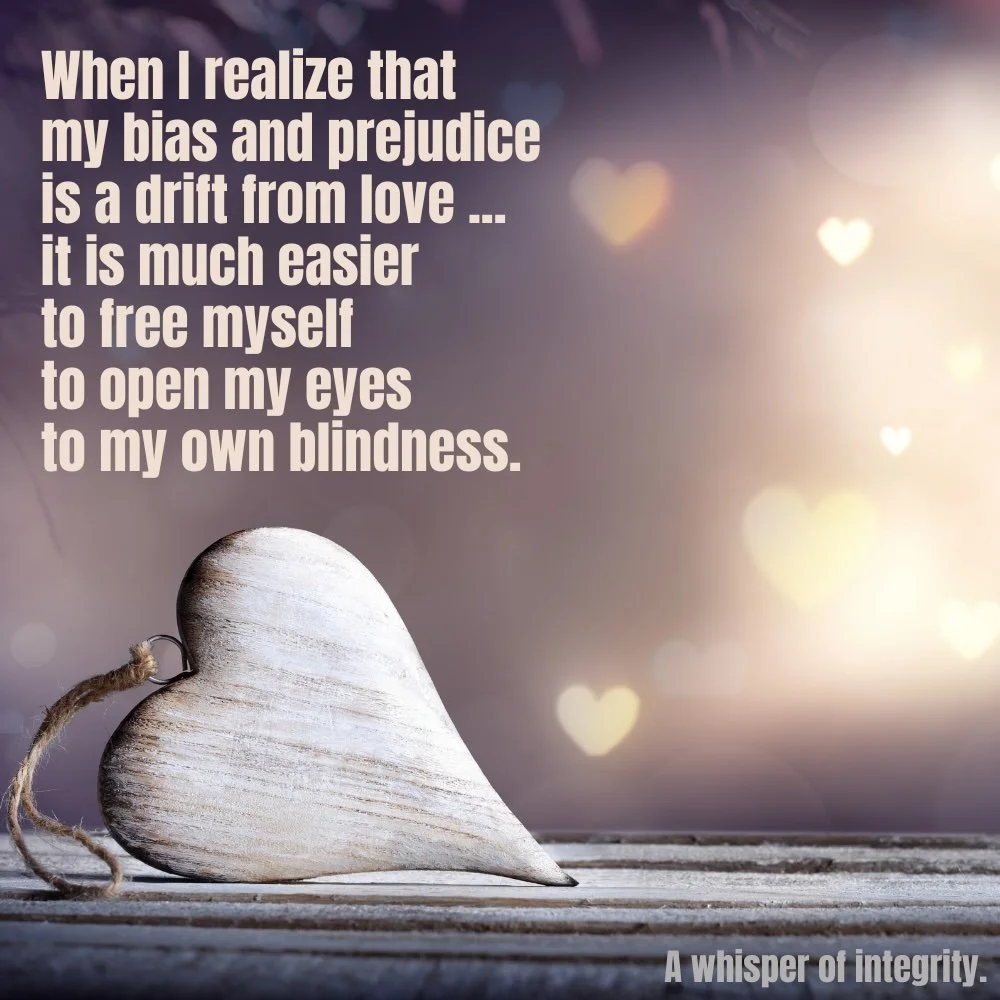
When I realize that my bias and prejudice is a drift from love ... it is much easier to free myself to open my eyes to my own blindness.
When I realize that my bias and prejudice is a drift from love ... it is much easier to free myself to open my eyes to my own blindness.
Stand at the edge of the ocean and a rip current is nearly impossible to see. It doesn't announce itself with crashing waves. Often it looks like the calmest stretch of water. Smoother. Easier. The obvious place to wade in. That's exactly what makes it dangerous. You don't feel it take hold. You're simply swimming, doing what seems reasonable, and then you look up and the shore is much farther away than you meant to go. Bias works the same way. We imagine it as something loud and obvious, something only other people are guilty of. But most bias is a quiet current. It rarely feels like prejudice from the inside. It feels like the reasonable position, the calm water, the obvious way to see things. And little by little, without ever deciding to, we drift — away from the shore, away from love, out past where we ever meant to be.
Here is what changes everything: the moment I realize I've drifted. Not that I'm a bad person, not that I've failed some moral test — simply that the current caught me, the way currents catch everyone. That realization isn't an accusation. It's a rescue. Because guilt keeps my eyes closed. It makes me defensive, and defensiveness only pulls me further out. But the moment I see the drift for what it is — a movement away from love rather than a verdict on my character — something loosens. My eyes can open. And while I couldn't see the current on my own at all, often someone else can. Standing where I couldn't stand, seeing what I couldn't see, loving me enough to call across the water. Their sight became the beginning of mine. Maybe that's what love does most quietly of all. It notices the drift we can't feel — and opens the possibility of our journey back to shore.
For further reflection
Where might I have quietly drifted from love without realizing it? Who in my life can often see the current I am temporarily blinded to?