
More than a blog. It’s a practice.
What are the Whispers and Echoes?
In a world that moves fast and measures everything, these gentle reminders invite you to pause. They point you inward — toward what truly matters, what can't be quantified, what calls you home to wholeness.
Visit here each weekday to read the latest whisper or conveniently receive them in your email inbox with a complimentary subscription. You can subscribe here. You can invite friends to join in this practice by sharing this link with them: JohnBlumberg.com/NEXT
A Whisper of Wholeness
One can go much further by going nowhere and having deep meaning than by going everywhere with no meaning at all.
One can go much further by going nowhere and having deep meaning than by going everywhere with no meaning at all.
Just get me to Friday. I can't count how many times I've said it. Sometimes about a hard week, but just as often about a good one. Get me through this meeting. Past this deadline. On to the next thing. And when Friday finally comes, some part of me is already leaning toward Monday. We rarely notice how much of life we spend standing in the next moment instead of this one. Even vacations get organized into itineraries — seven cities in ten days, every hour accounted for, a phone full of photos of places we never really were. We go everywhere. We cover enormous ground. And somehow we arrive home having been almost nowhere at all.
Years ago, I committed to walking the same prairie path near my home several times a week. Each walk the same limestone trail. The same long stretch of fields filled with what most people would call weeds in their own yard. For weeks it felt like going nowhere, and in a way, in the routine of it all … it was. Every time, I ended up right back where I started. Then one August afternoon, somewhere along a walk I'd taken so many times, I noticed the "weeds" had become a bouquet. Wildflowers were boasting everywhere I looked. They had likely been blooming for weeks. I simply hadn't been present to see them. Not really present. Instead, I had been walking toward the finish line. That prairie has taken me further than most of my travels ever have. Not because it offered more, but because it was quietly waiting for me to stop living ahead of it. Maybe going nowhere was never the problem. It's just the way being now-here seems to a mind in a hurry.
For further reflection
What moment am I trying to get through right now that might be asking me simply to be in it?
A Whisper of Wholeness
Integrity guides with gentle grace. Not harsh judgment.
Integrity guides with gentle grace. Not harsh judgment.
Picture a river after a heavy spring rain. The current runs fast and strong, and in the middle of it you are clinging to a rock with everything you have. Knuckles white. Arms burning. From the inside, the river feels like the enemy — relentless, trying to tear you loose. But the river isn't punishing you. It's simply moving toward everything waiting downstream. The pain isn't coming from the current. It's coming from the grip. We tend to imagine integrity as the harsh one. The stern inner voice keeping score. The judge who notices every way we've fallen short. So we brace against it, gripping whatever feels solid. A position, a habit, an old version of ourselves — and call the ache proof that integrity is hard. Demanding.
Yet integrity doesn't sound like that. It never has. That harsh voice is usually something else wearing integrity's clothes. The ego, keeping its ledger and demanding a performance. Integrity guides. It walks beside you. It points toward what's ahead without ever shoving you there. And its gentleness isn't weakness or permission. It's strength is patient enough to be trusted. Harshness only tightens the hands. Fear grips harder. Shame clings to the rock. The only thing that has ever loosened my fingers is a voice gentle enough to make letting go feel safe. You cannot be shamed into wholeness. You can only be guided there. Grace doesn't calm the river. It reminds you that you were never meant to fight it — and that there is more waiting. Just not here. Downstream where integrity takes you.
For further reflection
What am I clinging to right now because a harsh voice told me to hold on — and what might a gentler voice be inviting me to release?
A Whisper of Wholeness
Integrity isn't about feeling good. It is about being bothered by what isn't good for the greater whole.
Integrity isn't about feeling good. It is about being bothered by what isn't good for the greater whole.
We've quietly made integrity into a way to feel good about ourselves. Something to perform well enough or comply-with fully enough. We can look in the mirror and feel settled. Proud, even. And there's nothing wrong with feeling good. Until feeling good becomes the measure. Because by that measure, real integrity often fails. Integrity often leaves you feeling unsettled. It leaves you bothered. It's an outcome no one else has questioned that somehow won't let you rest. The arrangement everyone found acceptable that quietly keeps you up at night. We assume the discomfort means something is wrong with us. But what if that bothered feeling was never the problem? What if it's the alarm doing exactly what it was made to do?
Think of physical pain for a moment. We spend our lives trying to avoid it, and understandably so. But pain is one of the body's most loving gifts. The hand yanked back from the stove. The stone you can't ignore in your shoe. Pain isn't cruelty. It's the body refusing to let you harm what it loves. The people who cannot feel pain don't live in peace. They live in danger, wounding themselves without ever first knowing. And I've come to believe integrity works the very same way. That bother you feel when something isn't good for the whole — your family, your team, your community, the people not even in the room — isn't a malfunction. It's the nerve that still works. It's the part of you that hasn't gone numb to the fragmentation others have stopped noticing. Feeling good would be easier. Numbness always is. But numbness isn't peace. It's disconnection wearing a costume of peace. Maybe the bother was never the enemy of goodness. Maybe it was goodness — aching quietly to restore what it can still feel coming apart.
For further reflection
What have I been trying to soothe away that might actually be integrity — aching to restore something that isn't yet whole?
A Whisper of Wholeness
When I realize that my bias and prejudice is a drift from love ... it is much easier to free myself to open my eyes to my own blindness.
When I realize that my bias and prejudice is a drift from love ... it is much easier to free myself to open my eyes to my own blindness.
Stand at the edge of the ocean and a rip current is nearly impossible to see. It doesn't announce itself with crashing waves. Often it looks like the calmest stretch of water. Smoother. Easier. The obvious place to wade in. That's exactly what makes it dangerous. You don't feel it take hold. You're simply swimming, doing what seems reasonable, and then you look up and the shore is much farther away than you meant to go. Bias works the same way. We imagine it as something loud and obvious, something only other people are guilty of. But most bias is a quiet current. It rarely feels like prejudice from the inside. It feels like the reasonable position, the calm water, the obvious way to see things. And little by little, without ever deciding to, we drift — away from the shore, away from love, out past where we ever meant to be.
Here is what changes everything: the moment I realize I've drifted. Not that I'm a bad person, not that I've failed some moral test — simply that the current caught me, the way currents catch everyone. That realization isn't an accusation. It's a rescue. Because guilt keeps my eyes closed. It makes me defensive, and defensiveness only pulls me further out. But the moment I see the drift for what it is — a movement away from love rather than a verdict on my character — something loosens. My eyes can open. And while I couldn't see the current on my own at all, often someone else can. Standing where I couldn't stand, seeing what I couldn't see, loving me enough to call across the water. Their sight became the beginning of mine. Maybe that's what love does most quietly of all. It notices the drift we can't feel — and opens the possibility of our journey back to shore.
For further reflection
Where might I have quietly drifted from love without realizing it? Who in my life can often see the current I am temporarily blinded to?
A Whisper of Wholeness
Wonder is not a way of living. It is a way of seeing.
Wonder is not a way of living. It is a way of seeing.
Two people stand at the same window as the same sun goes down. The sun and the sky do what they do. Together creating the slow bleed of orange into rose into a violet that has no name. Yet of the two people, one barely registers it. Already thinking about dinner, reaching habitually for their phone, somewhere other than here. Yet beside them, the other goes completely still. Something in the chest releases, letting go of the body, the schedule, the list — and self. Same sky. Same light. Same handful of minutes. And yet one of them witnesses a change in the time of day while the other, briefly, is undone by beauty. The sunset didn't choose between them. They chose. Or rather, something in how they were already seeing chose for them.
I once heard someone share that the deepest shift isn't in what you see. It's in where you see it from. That has stayed with me for years, because it names something we usually get backwards. We think wonder is a reward the world occasionally hands us. A spectacular view. A rare moment. Something impressive enough to break through. But wonder isn’t waiting in the sunset. It is waiting in us. It's the place we see from before our eyes land on anything at all. It is a kind of inner availability, an openness that the noise and the hurry quietly close. When I've missed the most beautiful things in my life, it was almost never because they weren't there. It was because I wasn't. Perhaps wonder isn't something we go looking for. Maybe it's what becomes possible the moment we empty ourselves enough to allow the wonder within to see what is right in front of us.
For further reflection
What ordinary thing might become extraordinary today — not because it changed, but because I finally saw it from a place of wonder?
A Whisper of Wholeness
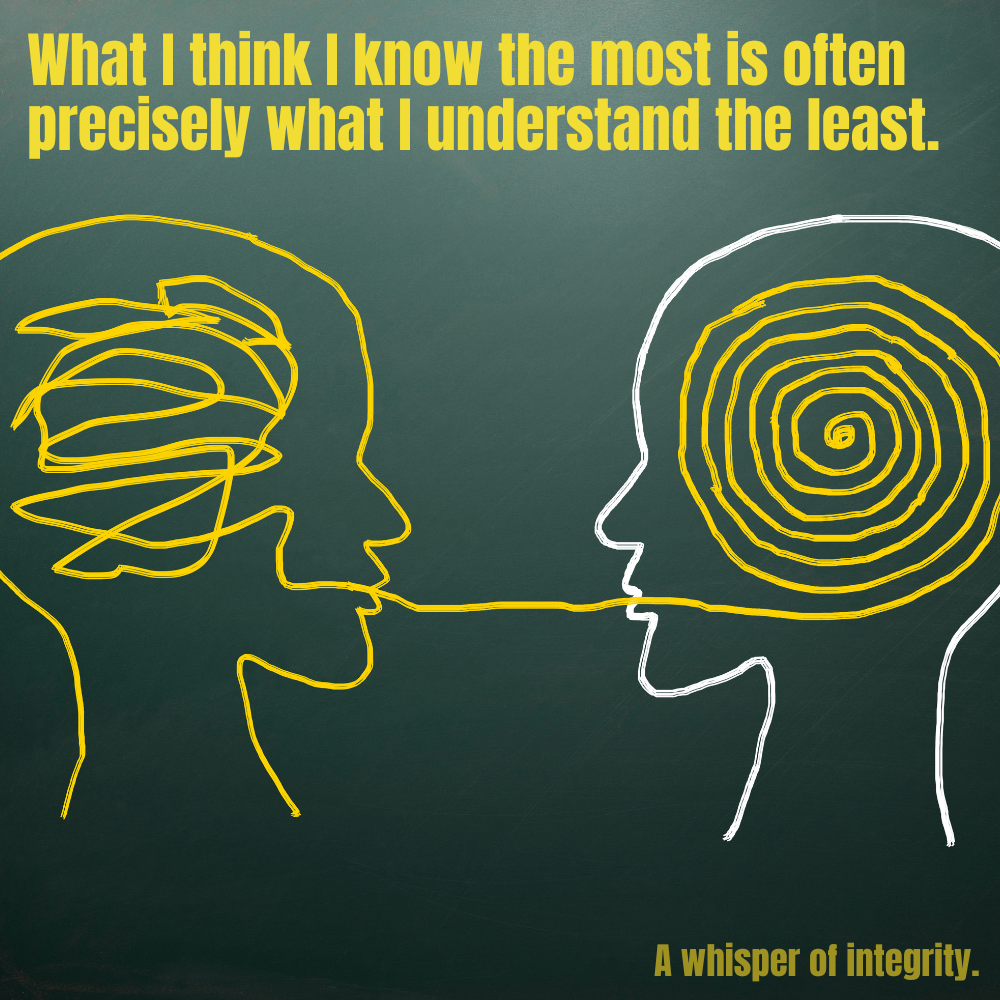
What I think I know the most is often precisely what I understand the least.
What I think I know the most is often precisely what I understand the least.
Knowing feels like arrival. The moment we're certain we know something, a quiet door closes. We stop asking about it. We stop looking at it. We file it away as settled and move on to the things we haven't figured out yet. And that seems to make sense — you can't reexamine everything all the time. But here's the trap: the things we're most certain we know are often the things we've examined the least in recent years. We've lived beside them so long that familiarity started impersonating understanding. We know the name. Yet, we’ve forgotten the face. And because we're so sure, we never think to look again. And all the while most everything has changed.
The ego loves this arrangement. Certainty feels like control. Being on top of things. Standing on solid ground. Understanding invites something far riskier. It asks you to say the most vulnerable sentence there is: I don't understand this as well as I thought I did. That sentence feels like weakness. It isn't. It's the gym where real strength gets built and the lab where every discovery is born. Nothing new was ever found on the safe shore of what we already know. From there you might observe, yet rarely discover. You must be willing to leave it — to sail out past the comfortable certainties into the open water of genuine not-knowing. And what I keep discovering, every time I'm brave enough to admit I understand less than I assumed, is that the admission isn't the end of anything. It's the beginning of everything. Maybe the deepest understanding begins with the courage to unknow and the humility to let go of what we were so sure we knew.
For further reflection
What is one thing I'm certain I know well that might be inviting me — if I have the courage — to look at it again with fresh and unknowing eyes?

A Whisper of Wholeness
The sole pursuit of more often results in a soulless destination of less.
The sole pursuit of more often results in a soulless destination of less.
There's a word hiding inside this whisper. Move one letter and "sole" becomes "soul." That may be the smallest and most important distance in the English language. A sole pursuit — the only thing driving you — seems focused. Ambitious. Directed. But when the only direction is more, something essential quietly exits the journey. More revenue. More recognition. More impact. More reach. Even more good. Each one reasonable on its own. Each one dangerous when it becomes the sole thing you're chasing — because the pursuit of more has a way of hollowing out the very destination it promises to fill. You arrive with your arms full. And something inside you empty.
The tricky part is that “more” rarely presents itself as greed. It’s way too clever to fall for that. It looks like ambition. Drive. Purpose. It wears the clothing of goals worth pursuing and lives worth building. Few question the person pursuing more, especially when that more seems worthy. They are celebrated and frequently bestowed with recognition. But there's a question that cuts through every version of more, no matter how noble the packaging: When is enough, enough? That question isn't a limitation. It's a defibrillator. A jolt that resets every system back to what actually matters. Because the answer reveals whether the pursuit is coming from your soul or simply consuming it. I've chased more in seasons where I had everything I needed and couldn't see it. The destination kept moving because the pursuit had become its own engine. Running on momentum. Draining most everything meaningful. Maybe less isn't a failure of ambition after all. Maybe it's where the soul waits in stillness — quietly, patiently — in the space that “more” couldn’t care less in taking the time to fill.
For further reflection
What am I currently pursuing more of — and is the pursuit being fueled by my soul or slowly trying to replace it?

A Whisper of Wholeness
Integrity isn't about being right. It is about being whole.
Integrity isn't about being right. It is about being whole.
There's a version of integrity that most of us were handed without ever questioning it. And most embraced it: integrity means knowing right from wrong. Standing on the right side. Having the right answers. Being, above all else, right. And we attempted to measure noble living around that version — ourselves by how correct we were, how consistently we chose the proper side, how few mistakes we made. And, of course, we did the same with others. It felt like integrity. It had the shape of it. But somewhere inside that relentless pursuit of rightness, something quietly fragmented. Because being right requires walls. It requires sorting the world into categories — this is correct, that is not. This person agrees with me, that one doesn't. And every wall built in the name of being right is a connection that being whole would never have severed.
Right is a position. Whole is a condition. You can be right at breakfast and wrong by dinner — rightness depends on information, context, the angle you happen to be standing in. Wholeness doesn't shift like that. It isn't contingent on whether your answer holds up. It's the experience of everything inside you being integrated — connected to itself, connected to others, connected to something larger than any single opinion you hold. The word "being" appears twice in this whisper, and it means two different things. Being right is something you perform. Being whole is something you are. One will eventually exhaust you. The other restores you. Maybe the question was never whether you got it right. Maybe it was always whether you're whole enough to hold whatever you find — including the possibility that you might be wrong — without anything inside you falling apart.
For further reflection
Where in my life am I chasing being right at the cost of being whole — and what might it feel like to let wholeness be enough?

A Whisper of Wholeness
Skills we label as "soft" may simply expose what has hardened within us.
Skills we label as "soft" may simply expose what has hardened within us.
We invented a hierarchy. Somewhere along the way, we divided human capacities into two categories. Hard and Soft. And then decided which ones mattered. The hard skills got the corner office. Strategy, analysis, execution, results. Measurable. Provable. Safe. The soft skills got a polite nod and a seat in the back. Empathy, vulnerability, listening, presence. Important in theory. Dismissed in practice. And the label itself tells you everything. You don't call something soft unless you've already decided it's less. Less rigorous. Less valuable. Less worthy of your time. But what if that label isn't describing the skill at all? What if it's describing what's happened inside the person using the label?
That's what this whisper quietly exposes. The act of labeling something soft is itself a symptom. Not of strength — of hardening. Something inside calcified so slowly that the only way to protect it was to diminish anything that might soften it back. Empathy gets called soft by the person who can no longer afford to feel. Vulnerability gets called soft by the person whose armor has become their identity. The label doesn't diminish the skill. It exposes the labeler. And therein sits the deeper irony: the skills we dismiss as soft may actually require the hardest transformation we'll ever face. Because they ask us to go to the very place our hardening was designed to avoid — the unguarded interior where no metric can protect us. And no result can substitute for who we actually are. What we label as soft might be the bravest thing we'll ever have to become ourselves. And certainly to offer others.
For further reflection
What is one thing I've been dismissing as "soft" that might actually be exposing something in me that has quietly hardened?

A Whisper of Wholeness
It is often one's attachments that cause the greatest drift. They are very glad to take you ... exactly where they need you.
It is often one's attachments that cause the greatest drift. They are very glad to take you ... exactly where they need you.
There's a ride at many amusement parks that spins so fast it pins you to the wall. The floor drops feet below without a problem. Because you can't move. You can barely breathe. And the strangest part — you're laughing. It feels like freedom. It feels like living. But you're not going anywhere. You're pinned in place by a force you volunteered for, spinning in circles. Attachments work the same way. They don't drag you kicking and screaming. Especially the most cunning ones. They invite you on — with a thrill, a promise, a sense of purpose that feels too good to question. A title. A lifestyle. A version of success that everyone applauds. You hold on because it feels right. Because it feels earned. And somewhere in the spinning, you stop noticing that you're no longer choosing the direction. You are just along for the ride.
That's the nature of attachment. It doesn't feel like drifting because it feels so intentional. You chose this. You worked for this. You deserve this. And yet this whisper says something unsettling: your attachments are very glad to take you exactly where they need you. Not where you need you. But where they need you. The attachment has its own destination, and it needs you along for the ride to keep itself alive. I've been pinned to that wall more times than I'd like to admit — spinning in something that felt like purpose but was actually just momentum without a meaningful destination. The hardest attachments to release aren't the ones that feel wrong. They're the ones that still feel right. Maybe the first step off the ride isn't letting go of something bad. It's being honest about whether something that feels good is actually taking you somewhere real.
For further reflection
What is one attachment in my life that still feels good — but might be taking me exactly where it needs me instead of where I'm meant to go?

A Whisper of Wholeness
Love is not an exchange. It is an orientation – a way of seeing.
Love is not an exchange. It is an orientation – a way of seeing.
We've made love very small. We've reduced it to a transaction — something given in hopes of something received. I love you becomes a question dressed as a statement, quietly waiting for its echo. And when the echo doesn't come, or doesn't come fast enough, or doesn't come in the shape we expected, we consider withdrawing the offer. As if love were a contract with terms and conditions. As if the value of what we gave depends entirely on what comes back. Like some kind of return on investment. We've romanticized love, commercialized it, and sometimes measured it by its return. And somewhere in all that measuring, we lost the thing itself. Because the moment love becomes an exchange, it stops being love. It becomes commerce with a softer name.
But there's a kind of love that has nothing to do with what comes back. It's not a feeling you summon or a decision you make person by person. It's an orientation. The direction you're already facing before you ever decide what to do. A way of seeing that changes everything you look at without changing anything about what's there. Someone once said to me that if integrity is the fabric of every core value, then love must be the fabric of integrity. That stopped me cold. Because it means love isn't one thread among many. It's the thread beneath every thread — the orientation from which wholeness, connection, depth, and every value draws its meaning. You don't practice love. You see through it. And what you see through love, you can never unsee.
For further reflection
What might shift in the way I see someone today if I approached them not as an exchange to be managed, but through this orientation of love?

A Whisper of Wholeness
Distractions are like shiny padlocks on the doorway to your greater depth.
Distractions are like shiny padlocks on the doorway to your greater depth.
The doorway is already there. That's the part we overlook. We talk about depth as though it requires us to find the way there — some elaborate project of building a path to a place we've never been. But the doorway to your greater depth isn't missing. It's just locked. And the locks are beautiful. That's what makes them so effective. A rusty padlock you'd want to remove. A shiny one you barely notice — or worse, you admire. Every distraction has a shine to it. The urgent email. The full calendar. The scroll that starts as a pause and swallows twenty minutes whole. Busyness that wears the mask of productivity. Each one clicks into place on the same door, quietly, one after another, until the doorway that was always open is buried under a collection of locks you placed there yourself.
The uncomfortable truth isn't that distractions steal your time. It's that they might be doing exactly what part of you wants — keeping you safely on this side of the door. Because depth asks something of you that busyness never will. It asks you to stop. To be still with whatever you find down there. No agenda. No metric for success. No shiny thing to reach for. Nor any judgement. Yet that stillness can feel less like freedom and more like freefall. But here's what sits on the other side of that doorway: not something to be afraid of, but everything you've been too locked-up to reach. The padlocks were never protecting you. They were protecting your shallowness from the depth that would outgrow it. The door has always been there. The handle works. You just have to set something shiny down long enough to reach for it.
For further reflection
What is one shiny distraction I keep reaching for that might be the very padlock standing between me and something deeper?

A Whisper of Wholeness
Integrity is an essence flowing from deep within … unless, of course, I choose to interrupt it for a perceived convenience.
Integrity is an essence flowing from deep within … unless, of course, I choose to interrupt it for a perceived convenience.
There's a flow within you that knows exactly where it's going. It doesn't need instructions. It doesn't need permission. Left uninterrupted, it moves through your decisions, your relationships, your way of being in the world with a kind of quiet intelligence that no strategy could replicate. You've felt it — those stretches when everything aligns, when your actions and your essence are moving in the same current. That's not performance. That's flow. The problem is rarely that the flow isn't there. The problem is how easily you can interrupt it. And how reasonable the interruption always seems. A shortcut here. A compromise there. A small adjustment to keep things moving, to meet the deadline, to avoid the discomfort of staying in the current when the current asks more of you than the moment feels worth. The interruption rarely announces itself as a betrayal. It shows up dressed as practicality.
That's the nature of a perceived convenience — it looks like wisdom until you notice what it cost. Not now. Later. You trade the flow for the fix. The essence for the efficient. And you probably didn't even feel it happen, because the interruption was small and the convenience was immediate. You got distracted. But the flow noticed. It always does. Every interruption leaves a gap — not dramatic, not catastrophic, just a quiet thinning of something that was full a moment before. The accumulation of those small gaps is the drift we never meant to take. Maybe the most honest question isn't whether integrity is flowing within you. It almost certainly is. The question is how often you're choosing — moment by moment, convenience by convenience — to step on the hose.
For further reflection
What is one small convenience I keep choosing that might be quietly interrupting something deeper trying to flow through me?

A Whisper of Wholeness
Integrity is not about a stand you take, but rather a fluid awareness that keeps you moving along the way.
Integrity is not about a stand you take, but rather a fluid awareness that keeps you moving along the way.
There's a phrase that used to hang on the wall of my convictions: If you don't stand for something, you'll fall for anything. It felt solid. Noble. Certain. And for a long time, I built a blind understanding of integrity around it — find your ground, plant your feet, don't move. But the longer I stood in that certainty, the more I noticed something unsettling: the ground beneath my stand wasn't always as solid as I thought. Sometimes what felt like firm conviction was actually just familiar conviction. And there's a significant difference. A stand taken on solid ground is strength. A stand taken on quicksand is just sinking with confidence.
Integrity has very little interest in where I stand. It cares far more about how I flow. Not going with the flow. That's abdication. And not drifting. That's unconsciousness. But being the flow. A river doesn't take a stand. It doesn't need to. It knows where it's going — not because it planted a flag, but because its source is clear and carried within. Its awareness is constant. It moves around obstacles that a rigid stance would crash against. And break. It finds pathways that standing still would never reveal. This fluid awareness isn't weakness. It's a deeper kind of strength — the kind that stays connected to its source while responding to every bend in every season. I once thought integrity meant never moving from where I stood. Now I think it means never losing awareness of who I am — while being willing to move in connection with everything else.
For further reflection
Am I standing somewhere right now out of genuine conviction — or out of the fear of what might happen if I was willing to flow?

A Whisper of Wholeness
When your brand is perfection your reality is illusion.
When your brand is perfection your reality is illusion.
We don't usually set out to create an illusion. We set out to present our best. And there's nothing wrong with that. We all want to show up well — to be seen as competent, trustworthy, whole. But somewhere between putting our best foot forward and perfecting the presentation, something shifts. The best version of ourselves quietly becomes the only version we're willing to show. The rough edges get smoothed. The uncertainties get hidden. The struggles get edited out. And what remains is a brand — polished, consistent, impressive. It looks like a garden in full bloom. The only problem is that nothing is actually growing. A silk flower never wilts. It also never lives. When perfection becomes the brand, the real garden underneath — messy, seasonal, imperfect — slowly becomes something we hide rather than tend.
The deeper danger isn't that others believe the brand. It's that we do. I've spent seasons so committed to the polished version that I lost contact with the real one. The brand became the master and I became its maintenance crew — managing impressions rather than growing inside. And the exhausting irony is this: the very imperfections I was hiding were the most trustworthy things about me. People don't connect with perfection. They might be impressed by it. And perhaps might feel diminished by it. Within us and between us, we connect with what's real — the cracks, the seasons, the visible evidence of a life being lived rather than performed. Maybe the most authentic brand isn't one we build at all. It's what others experience when we stop building and simply grow right along with them.
For further reflection
Where in my life am I maintaining a brand — and what might others experience if I trusted the real garden instead?

A Whisper of Wholeness
So easy it can be to drift from anticipation to expectation. It's a drift that empties the soul of the gift.
Tightly holding onto an old way of thinking is precisely what prevents one from a new way of seeing.
Anticipation is one of the most alive experiences we can feel. It doesn't know what's coming — and that not-knowing is the gift within the gift. There's a fullness in waiting when your hands are open. A quiet energy. A leaning-forward that has nothing to prove and everything to receive. But somewhere along the way — so subtly we don't notice — the anticipation begins to harden. "I wonder what will come" becomes "I know what should come." The open hands begin to close. Not into fists exactly, but into something with a shape — a picture of what the gift should look like. When it should arrive. How it should feel. And the moment we hold that picture, we've stopped receiving the gift. We've started grading it.
That's the drift. Not from something good to something bad. Yet from something alive to something measured. Expectation isn't evil. It's just anticipation with the wonder removed. The box without the gift inside. I've watched it happen in my own life more times than I'd like to admit. The slow slide from hope to assumption — from gratitude to audit. A relationship that once filled me with wonder quietly became something I monitored for performance. A calling that once stirred awe slowly became a career I managed for outcomes. The gift was still there. But I had emptied the soul of it by deciding in advance what I expected from it. Maybe the most generous thing I can do — for the gift and for myself — is to keep my hands open long enough to simply be surprised by what arrives.
For further reflection
Where in my life has my anticipation quietly hardened into expectation — and what gift might I be missing because I've already decided what it should look like?

A Whisper of Wholeness
Tightly holding onto an old way of thinking is precisely what prevents one from a new way of seeing.
Tightly holding onto an old way of thinking is precisely what prevents one from a new way of seeing.
We don't hold onto an old way of thinking because it has failed us. We hold onto it because it worked. It gave us language for things we couldn't name, a framework for complexity we couldn't navigate, clarity when everything felt uncertain. We're grateful. And we should be. But gratitude can quietly become a cage when it turns into permanence. The insight that was meant to carry us through a season can become the lens we use for every season after. Even when the landscape has completely changed. We're not holding on because we're stubborn. We're holding on because letting go of something that once served us so well feels like dishonoring it. But here's what I'm beginning to understand: nothing dishonors a great insight more than refusing to outgrow it.
There's a difference between thinking and seeing that most of us never notice — because thinking is so much louder. Thinking organizes, defends, categorizes. It builds a map and then insists the territory match. Seeing does something else entirely. It takes in what's actually there before the mind can sort it. It lets the territory reveal itself — even when it contradicts the map. I've carried maps that served me beautifully for years, only to realize they were keeping me from seeing what was actually in front of me. The old thinking wasn't wrong. It is finished. And a new way of seeing couldn't arrive until I set the old thinking down. Unlearning isn't forgetting. It isn't betrayal. It's the deepest form of honoring what something taught you — by trusting that it prepared you for whatever comes next. Even if, for now, what comes next can only be seen, not thought.
For further reflection
What is one way of thinking that served me well in an earlier season but might now be standing between me and a new way of seeing?

A Whisper of Wholeness
The beauty within the most stunning bouquets is experienced through the harmony of their diverse nature.
The beauty within the most stunning bouquets is experienced through the harmony of their diverse nature.
Sameness is easy on the eyes. A row of identical flowers — same height, same color, same direction — feels orderly, manageable, complete. Nothing out of place. Nothing to question. We're drawn to uniformity because it asks nothing of us. We can take it in without adjusting. But the bouquets that actually stop you — the ones that make you catch your breath — are never the uniform ones. They're the ones that look, at first glance, like they shouldn't work at all. Different colors shouldering against each other. Different shapes competing for space. No visible organizing principle. What looks like chaos from the outside is beauty waiting for your eyes to catch up.
That catching-up is everything. It's the moment when something shifts — not in what you're looking at, but in you. The differences don't rearrange themselves. You rearrange. What felt like disorder slowly reveals itself as a harmony you couldn't have designed. Yet you can appreciate. Eventually, even long for. I've noticed this doesn't just happen with flowers. It happens with people, with ideas, with seasons of life that looked like chaos while I was in the middle of them. The beauty was already there. I just couldn't see it until I stopped insisting that everything match. Everything nicely fit. A curated life might look impressive. But the most stunning version of a life — like the most stunning bouquet — is experienced only when we stop arranging and start seeing. Not sameness. Harmony. The kind that could only come from things brave enough to be completely different and still stand together.
For further reflection
Where in my life am I still arranging things to match when the beauty might already be present in the diversity I've been trying to organize away?

A Whisper of Wholeness
Integrity doesn't depend on you being correct. It depends on you realizing you are connected ... to everything and everyone.
Integrity doesn't depend on you being correct. It depends on you realizing you are connected ... to everything and everyone.
We arrive in the world without any sense of separation. No walls, no sides, no sense of where we end and everything else begins. Then slowly, necessarily, a self develops — an identity, a perspective, a way of navigating a complex world. And that self is a gift. It has to be. You can't function without it. But somewhere along the way, the self becomes the whole project. We start keeping score. Building cases. Measuring ourselves by how often we're right, how persuasively we argue, how clearly we can prove that our way of seeing is the correct one. Being correct becomes a kind of currency. A currency we spend without realizing what it's costing us. Every argument won is a connection we didn't notice. Every point proven is a bridge we walked past without crossing.
Connection was never something we needed to build. It was something we were born into and slowly forgot. Not because we're selfish. Because we got distracted. The self that was supposed to help us navigate the world began convincing us that navigating meant competing. And competing meant winning. And winning meant being correct. I've been caught in that loop more times than I'd like to admit. What I'm slowly beginning to realize is that integrity never once asked me to be right. It only ever asked me to be aware. Aware that I am a piece of something — although whole — I’m not the whole of it. My whole piece only makes sense when it remembers the greater whole. I can be correct and completely disconnected. I can also be uncertain, even wrong, and more deeply connected than I've ever been. Maybe the whole journey — the keeping score, the building cases, the needing to be right — was just the long route back to the connection I arrived with.
For further reflection
Where am I investing more energy in being right than in being connected? What might I experience if I let go of the need to win?

A Whisper of Wholeness
When we are not whole, we fragment everything. Yet wholeness is always waiting within for the opportunity to grow. Again.
When we are not whole, we fragment everything. Yet wholeness is always waiting within for the opportunity to grow. Again.
There's something about fragmentation that doesn't stay contained. It moves outward. When something inside us is fractured — unresolved, disconnected, out of alignment — we don't just carry it privately. We bring it into every room, every conversation, every decision. We fragment our relationships by showing up as pieces instead of a whole person. We fragment our seeing by projecting our own cracks onto what's in front of us. And most of the time, we don't even realize it's happening. We look at a fractured situation and assume the fractures started out there. It rarely occurs to us that what we're seeing might be a reflection of what we're carrying. What I am becomes what I create. Quietly. Systemically. In every direction. On every level.
But here's what still amazes me about wholeness: it doesn't leave. No matter how many times I've fragmented things around me — relationships, decisions, my own sense of direction — wholeness has never once packed up and moved on. It stays. Within. Waiting. Not with arms crossed and a lesson to deliver, but with the kind of patience that only something unconditional can sustain. I've walked away from my own wholeness more times than I can count, and every single time I've turned back, it was still there. Not diminished. Not resentful. Always ready. That word at the end of this whisper — again — might be the most grace-filled word in the entire thought. It means there's no limit to the invitation. Wholeness doesn't keep score. It just keeps the light on. Again. And again. And again.
For further reflection
What is one area of my life where the fragmentation I see around me might actually be a reflection of something unresolved within me? What would it look like to turn toward wholeness again?