
More than a blog. It’s a practice.
What are the Whispers and Echoes?
In a world that moves fast and measures everything, these gentle reminders invite you to pause. They point you inward — toward what truly matters, what can't be quantified, what calls you home to wholeness.
Visit here each weekday to read the latest whisper or conveniently receive them in your email inbox with a complimentary subscription. You can subscribe here. You can invite friends to join in this practice by sharing this link with them: JohnBlumberg.com/NEXT
A Whisper of Wholeness
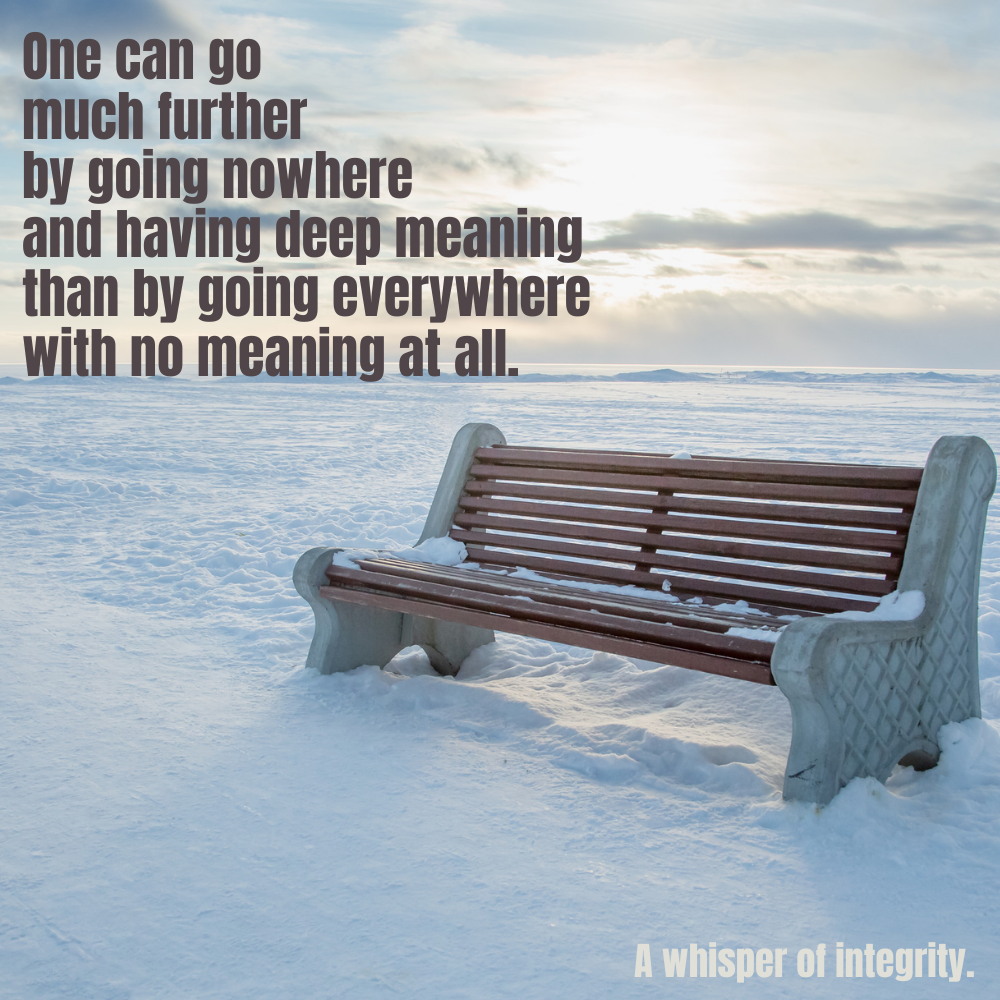
One can go much further by going nowhere and having deep meaning than by going everywhere with no meaning at all.
One can go much further by going nowhere and having deep meaning than by going everywhere with no meaning at all.
Just get me to Friday. I can't count how many times I've said it. Sometimes about a hard week, but just as often about a good one. Get me through this meeting. Past this deadline. On to the next thing. And when Friday finally comes, some part of me is already leaning toward Monday. We rarely notice how much of life we spend standing in the next moment instead of this one. Even vacations get organized into itineraries — seven cities in ten days, every hour accounted for, a phone full of photos of places we never really were. We go everywhere. We cover enormous ground. And somehow we arrive home having been almost nowhere at all.
Years ago, I committed to walking the same prairie path near my home several times a week. Each walk the same limestone trail. The same long stretch of fields filled with what most people would call weeds in their own yard. For weeks it felt like going nowhere, and in a way, in the routine of it all … it was. Every time, I ended up right back where I started. Then one August afternoon, somewhere along a walk I'd taken so many times, I noticed the "weeds" had become a bouquet. Wildflowers were boasting everywhere I looked. They had likely been blooming for weeks. I simply hadn't been present to see them. Not really present. Instead, I had been walking toward the finish line. That prairie has taken me further than most of my travels ever have. Not because it offered more, but because it was quietly waiting for me to stop living ahead of it. Maybe going nowhere was never the problem. It's just the way being now-here seems to a mind in a hurry.
For further reflection
What moment am I trying to get through right now that might be asking me simply to be in it?
A Whisper of Wholeness
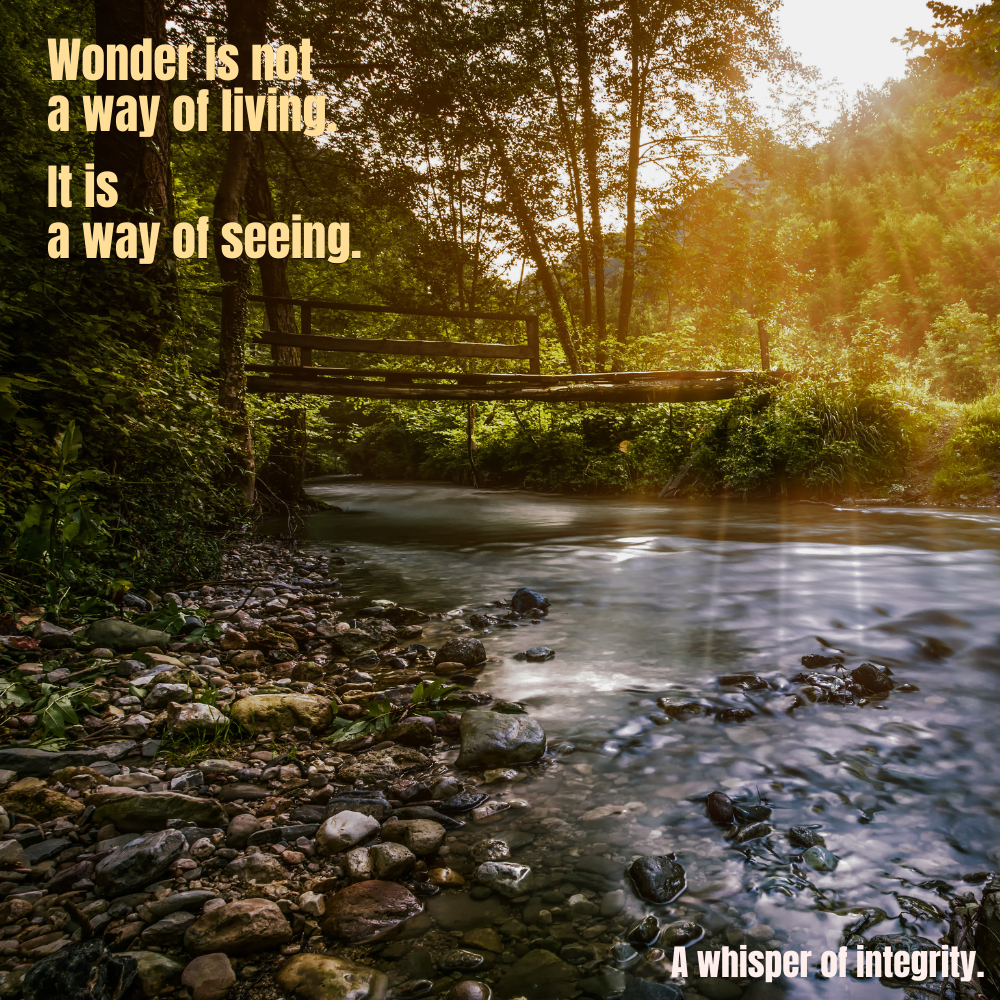
Wonder is not a way of living. It is a way of seeing.
Wonder is not a way of living. It is a way of seeing.
Two people stand at the same window as the same sun goes down. The sun and the sky do what they do. Together creating the slow bleed of orange into rose into a violet that has no name. Yet of the two people, one barely registers it. Already thinking about dinner, reaching habitually for their phone, somewhere other than here. Yet beside them, the other goes completely still. Something in the chest releases, letting go of the body, the schedule, the list — and self. Same sky. Same light. Same handful of minutes. And yet one of them witnesses a change in the time of day while the other, briefly, is undone by beauty. The sunset didn't choose between them. They chose. Or rather, something in how they were already seeing chose for them.
I once heard someone share that the deepest shift isn't in what you see. It's in where you see it from. That has stayed with me for years, because it names something we usually get backwards. We think wonder is a reward the world occasionally hands us. A spectacular view. A rare moment. Something impressive enough to break through. But wonder isn’t waiting in the sunset. It is waiting in us. It's the place we see from before our eyes land on anything at all. It is a kind of inner availability, an openness that the noise and the hurry quietly close. When I've missed the most beautiful things in my life, it was almost never because they weren't there. It was because I wasn't. Perhaps wonder isn't something we go looking for. Maybe it's what becomes possible the moment we empty ourselves enough to allow the wonder within to see what is right in front of us.
For further reflection
What ordinary thing might become extraordinary today — not because it changed, but because I finally saw it from a place of wonder?

A Whisper of Wholeness
Love is not an exchange. It is an orientation – a way of seeing.
Love is not an exchange. It is an orientation – a way of seeing.
We've made love very small. We've reduced it to a transaction — something given in hopes of something received. I love you becomes a question dressed as a statement, quietly waiting for its echo. And when the echo doesn't come, or doesn't come fast enough, or doesn't come in the shape we expected, we consider withdrawing the offer. As if love were a contract with terms and conditions. As if the value of what we gave depends entirely on what comes back. Like some kind of return on investment. We've romanticized love, commercialized it, and sometimes measured it by its return. And somewhere in all that measuring, we lost the thing itself. Because the moment love becomes an exchange, it stops being love. It becomes commerce with a softer name.
But there's a kind of love that has nothing to do with what comes back. It's not a feeling you summon or a decision you make person by person. It's an orientation. The direction you're already facing before you ever decide what to do. A way of seeing that changes everything you look at without changing anything about what's there. Someone once said to me that if integrity is the fabric of every core value, then love must be the fabric of integrity. That stopped me cold. Because it means love isn't one thread among many. It's the thread beneath every thread — the orientation from which wholeness, connection, depth, and every value draws its meaning. You don't practice love. You see through it. And what you see through love, you can never unsee.
For further reflection
What might shift in the way I see someone today if I approached them not as an exchange to be managed, but through this orientation of love?

A Whisper of Wholeness
Oh, that feeling of integrity after having drifted away. Just like a first day of spring!
Oh, that feeling of integrity after having drifted away. Just like a first day of spring!
Oh! There it is. That feeling you forgot you were missing. The one that doesn't announce itself with fanfare but arrives the way sunlight arrives on a morning you'd stopped expecting it. You've been away. Maybe for a while. Maybe so long that the distance stopped feeling like distance and started feeling like normal. The drift didn't happen all at once. It never does. Yet the return — it can happen in a single breath. In a moment. One moment — of honesty. One choice that lines up with something deeper than habit. And suddenly the weight you didn't know you were carrying lifts. Out of nowhere. Not because anything outside you changed. Because something inside you came home.
The first day of spring is never the one on the calendar. It's the day you step outside and feel it — that unmistakable warmth that has nothing to prove and everything to offer. A crocus pushing through soil that was frozen just last week. The air carrying something it wasn't carrying yesterday. You don't analyze spring. You receive it in the experience. And it fills you before you can think to resist it. I've drifted more times than I can count. Perhaps you have too. But what stays with me isn't the drifting. It's the feeling of return. Every single time. Realizing integrity had been waiting by the door the whole time I was gone, ready to welcome me back without a single question about where I'd been. Just warmth. Just light. Just the quiet joy of my soul recognizing that it's finally standing in its own spring. Again.
For further reflection
When was the last time I felt that unmistakable feeling of coming home to myself — and what small step might once again bring me home to it?

A Whisper of Wholeness
When your brand is perfection your reality is illusion.
When your brand is perfection your reality is illusion.
We don't usually set out to create an illusion. We set out to present our best. And there's nothing wrong with that. We all want to show up well — to be seen as competent, trustworthy, whole. But somewhere between putting our best foot forward and perfecting the presentation, something shifts. The best version of ourselves quietly becomes the only version we're willing to show. The rough edges get smoothed. The uncertainties get hidden. The struggles get edited out. And what remains is a brand — polished, consistent, impressive. It looks like a garden in full bloom. The only problem is that nothing is actually growing. A silk flower never wilts. It also never lives. When perfection becomes the brand, the real garden underneath — messy, seasonal, imperfect — slowly becomes something we hide rather than tend.
The deeper danger isn't that others believe the brand. It's that we do. I've spent seasons so committed to the polished version that I lost contact with the real one. The brand became the master and I became its maintenance crew — managing impressions rather than growing inside. And the exhausting irony is this: the very imperfections I was hiding were the most trustworthy things about me. People don't connect with perfection. They might be impressed by it. And perhaps might feel diminished by it. Within us and between us, we connect with what's real — the cracks, the seasons, the visible evidence of a life being lived rather than performed. Maybe the most authentic brand isn't one we build at all. It's what others experience when we stop building and simply grow right along with them.
For further reflection
Where in my life am I maintaining a brand — and what might others experience if I trusted the real garden instead?

A Whisper of Wholeness
The beauty within the most stunning bouquets is experienced through the harmony of their diverse nature.
The beauty within the most stunning bouquets is experienced through the harmony of their diverse nature.
Sameness is easy on the eyes. A row of identical flowers — same height, same color, same direction — feels orderly, manageable, complete. Nothing out of place. Nothing to question. We're drawn to uniformity because it asks nothing of us. We can take it in without adjusting. But the bouquets that actually stop you — the ones that make you catch your breath — are never the uniform ones. They're the ones that look, at first glance, like they shouldn't work at all. Different colors shouldering against each other. Different shapes competing for space. No visible organizing principle. What looks like chaos from the outside is beauty waiting for your eyes to catch up.
That catching-up is everything. It's the moment when something shifts — not in what you're looking at, but in you. The differences don't rearrange themselves. You rearrange. What felt like disorder slowly reveals itself as a harmony you couldn't have designed. Yet you can appreciate. Eventually, even long for. I've noticed this doesn't just happen with flowers. It happens with people, with ideas, with seasons of life that looked like chaos while I was in the middle of them. The beauty was already there. I just couldn't see it until I stopped insisting that everything match. Everything nicely fit. A curated life might look impressive. But the most stunning version of a life — like the most stunning bouquet — is experienced only when we stop arranging and start seeing. Not sameness. Harmony. The kind that could only come from things brave enough to be completely different and still stand together.
For further reflection
Where in my life am I still arranging things to match when the beauty might already be present in the diversity I've been trying to organize away?

A Whisper of Wholeness
Integrity is like golden adhesive mending and healing all that is broken.
Integrity is like golden adhesive mending and healing all that is broken.
There's an ancient Japanese art called kintsugi — the practice of repairing broken pottery with gold. Not hiding the cracks. Not discarding the pieces. Filling every fracture with something so precious that the break becomes the most beautiful part of the whole. It would be easier to throw the broken thing away. It would be faster to glue it back together and paint over the seams. But kintsugi does neither. It refuses to pretend the breaking didn't happen. And it refuses to believe the breaking is the end of the story. We tend toward the opposite ourselves. We hide the fractures. We perform wholeness while quietly falling apart inside. With an uncertain confidence, we navigate convinced that if anyone saw the cracks, they'd see someone who failed. Shame says: hide the break. Strength says: hold it together. But integrity says something else entirely.
Integrity says: let me mend that. Not fix it. Not erase it. Mend it — slowly and carefully. Making it golden. I've spent years trying to present an unbroken surface to the world, and what I've learned is that the people who've moved me most weren't the ones who appeared flawless. They were the ones who let me see their gold. Their mended places. Their healed fractures that they didn't hide but honored. There's a courage in that kind of visibility that perfection can never offer. Broken isn't wrong. It's real. And integrity doesn't ask us to be unbroken. It asks us to be willing to be mended — honestly, openly, with the kind of care that turns a crack into the most luminous thing in the room. The gold was never there to hide the damage. It was there to prove that the most beautiful wholeness has blemishes born from a brokenness willing to be healed.
For further reflection
What is one place in my life where I've been hiding a crack that might actually become something beautiful if I let it be mended instead of concealed?

A Whisper of Wholeness
It is the paradoxical melody of differences and togetherness that defines the beauty and integrity of bouquets and relationships.
It is the paradoxical melody of differences and togetherness that defines the beauty and integrity of bouquets and relationships.
There's a reason a single flower, no matter how stunning, isn't a bouquet. Something happens when differences come together — not blended into sameness, not stripped of what makes each one distinct, but held alongside one another in a way that creates something none of them could create alone. A melody works the same way. It isn't one note repeated. It's different notes finding their way into relationship — each one giving the others room to be heard. We know this intuitively about music and gardens. We just forget it about people. Division has a sound too, and it can feel surprisingly like harmony. Gossip, agreement built on a common enemy, offers the tight warmth of an inner circle. There's a belonging in it that feels real. Until it doesn't. Until the melody narrows to a single note and you realize the togetherness was built on separation all along.
Real harmony asks something harder. It asks you to hold your note while making room for one that sounds nothing like yours — and to trust that the tension between them is where the beauty lives. I've felt the difference between the two kinds of belonging. One is warm but shrinking. The other is wider than I expected and sometimes uncomfortable. Yet, it carries a resonance I can feel in my whole body. A breeze you can't manufacture. You either feel it or you've been standing in still air so long you've forgotten what moving air sounds like. The most beautiful bouquets aren't the ones where every flower matches. They're the ones where every flower belongs precisely because it doesn't.
For further reflection
Where in my life have I settled for the comfort of sameness when the fuller melody might be asking me to make room for a voice very different from my own?

A Whisper of Wholeness
Sometimes one needs to wander ... to remember how to wonder.
Sometimes one needs to wander ... to remember how to wonder.
We've become very good at moving on mission. Every step mapped, every hour accounted for, every route optimized for efficiency. And there's nothing wrong with that — until it becomes the only way we know how to move. Mission-driven lives are full lives. But they can also become lives where everything is a means to an end, where even a walk becomes a commute and a conversation becomes a transaction. Somewhere in all that missional motion, we stopped wandering. And when we stopped wandering, we slowly forgot how to wonder.
Wonder doesn't tend to announce itself in dramatic fashion. It rarely shows up in the moments we've planned for. I think we assume awe is reserved for the grand occasions — the breathtaking view, the once-in-a-lifetime experience. But I've begun to notice that awe has been quietly waiting in far smaller places. The way light moves through a window in late afternoon. A sentence someone says that stops me mid-step. The strange, ordinary miracle of a single conversation where two people actually hear each other. These moments aren't rare. I just stopped wandering long enough to notice them. Maybe wonder never left us. Maybe we just stopped giving it room to find us in one small, unhurried moment at a time.
For further reflection
When was the last time I wandered — without agenda — and noticed something that surprised me?

A Whisper of Wholeness
When I'm so busy insisting on how things should be I most often miss out on how beautiful they actually are.
When I'm so busy insisting on how things should be I most often miss out on how beautiful they actually are.
We're taught to see clearly — to assess, to measure, to know exactly where things stand. And somewhere along the way, that clarity becomes a kind of insistence. We develop sharp pictures of how our work should unfold, how people should respond, how progress should look. The sharper the picture, the more productive we feel. But there's a quiet cost to all that certainty. The tighter we grip our version of how things should be, the less we're able to see what is actually unfolding right in front of us. Confidence in our own clarity can become the very thing that blinds us.
Beauty rarely arrives on schedule. It doesn't match the plan or check the expected boxes. It shows up in the unscripted moment — the conversation that veered off-agenda, the outcome that looks nothing like what I mapped out, the ordinary Tuesday that suddenly holds something I almost walked right past. I wonder how many times I've been so certain about what I was looking for that I missed what was being offered. Maybe the most productive thing I could do today is loosen my grip on what should be — just enough to notice what already is.
For further reflection
What is one expectation I'm holding so tightly right now that it might be keeping me from seeing something beautiful?

A Whisper of Wholeness
Integrity is a rhythm. A flow. Not a checklist ... performance or standard.
Integrity is a rhythm. A flow. Not a checklist ... performance or standard.
We love a good checklist. There's something deeply satisfying about reducing life to lines we can cross off — a way of measuring ourselves that lets us believe we're on track. But integrity doesn't work that way. It isn't a score to be read note by note. It's more like music itself — something that moves, breathes, and sometimes catches us off guard with a sharp or a flat we never saw coming. And it's precisely those unexpected notes that keep the whole thing from becoming background noise.
Music has a word for the silence between notes. It's called a rest. Not a stop. Not a failure to play. A rest. It's written right into the composition — because without it, even the most beautiful notes collapse into chaos. I wonder how often we treat our own pauses as problems to fix rather than as part of the rhythm we're already living. Maybe integrity isn't something I perform. It's something I’m always already inside of — a rhythm that was playing long before I started trying to listen. And it doesn't need me to be perfect. It just needs me to stop forcing the tempo long enough to hear the rhythm.
For further reflection
Where in my life right now am I forcing a tempo that integrity isn't asking me to keep?

A Whisper of Wholeness
That which we allow to become too familiar blinds our ability to see how every thing is beautifully unique.
That which we allow to become too familiar blinds our ability to see how every thing is beautifully unique.
We stop seeing what we see every day. Not because it changes, but because we do. We settle into a kind of certainty about the people, the places, the routines that surround us. We learn their patterns. We label them. And once something has a label, we stop looking at it. The label does the seeing for us. It's efficient. And it's blinding. Familiarity isn't the problem. Familiarity is a gift. The problem is what we allow familiarity to become — a substitute for presence. A shortcut past the very things most worthy of our attention.
There's a reason a child can stare at the same tree for ten minutes and still be astonished. They haven't decided what the tree is yet. They're still letting that one tree be what it is. Somewhere along the way, we traded that kind of seeing for something faster. Something more productive. But wholeness doesn't ask us to just see new things. It asks us to see familiar things as if they've never been seen before. That colleague I think I know. That conversation I assume will go the way it always goes. That tension I've already categorized and filed away. What if I looked again? Not for something different. For everything I've been missing by being so sure I already knew what was there.
For further reflection
What is one thing that has become so familiar in my life that I may have stopped truly seeing it — and what might it reveal if I looked again with unhurried eyes?