
More than a blog. It’s a practice.
What are the Whispers and Echoes?
In a world that moves fast and measures everything, these gentle reminders invite you to pause. They point you inward — toward what truly matters, what can't be quantified, what calls you home to wholeness.
Visit here each weekday to read the latest whisper or conveniently receive them in your email inbox with a complimentary subscription. You can subscribe here. You can invite friends to join in this practice by sharing this link with them: JohnBlumberg.com/NEXT
A Whisper of Wholeness
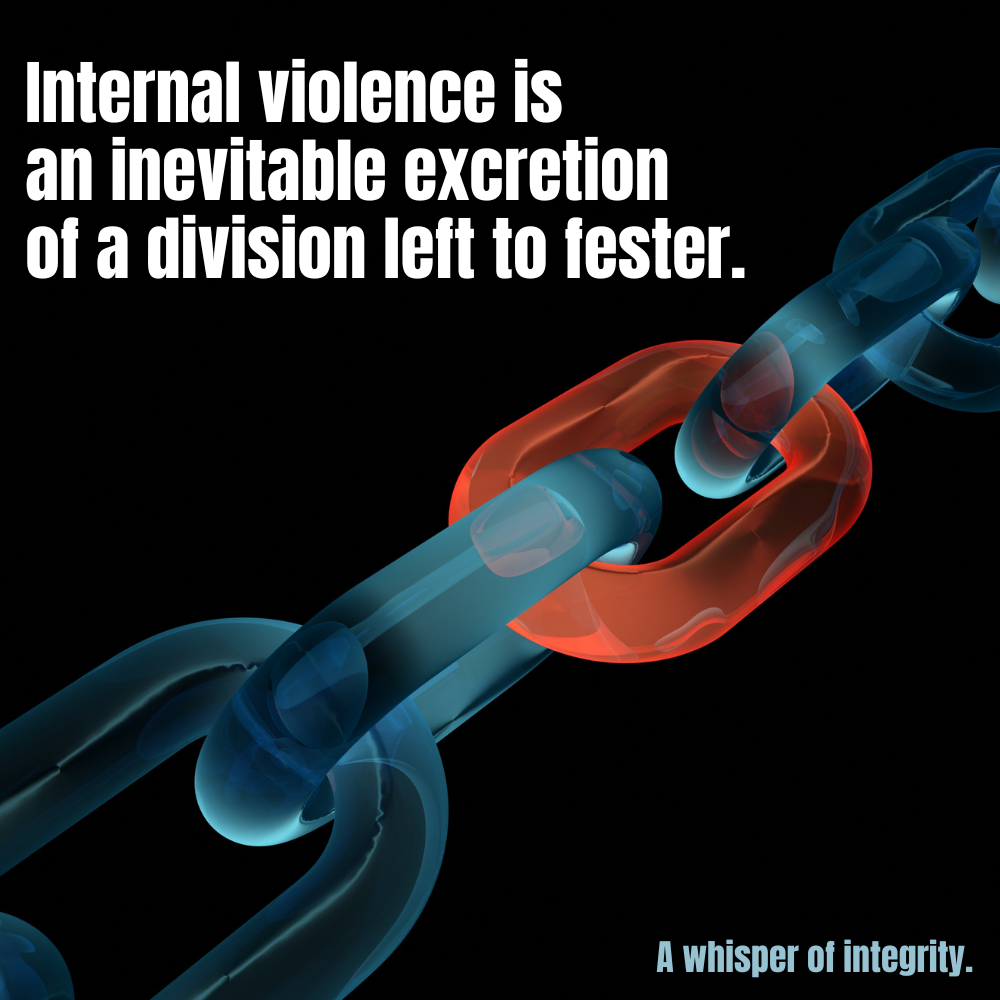
Internal violence is an inevitable excretion of a division left to fester.
Internal violence is an inevitable excretion of a division left to fester.
I can still picture the tweezers my mom kept for splinters. The gentle pressure she applied around the spot. “Sit still,” she would remind me. Then carefully, slowly and intentionally, she removed what didn’t belong. I never hid a splinter from her. I knew she would lovingly take care of it. Years later, on the road, it was a different story. Not hidden. Just postponed. I’ll get to it tonight at the hotel. And if the tweezers weren’t in my attaché case, a safety pin would have to do. Or whatever else had gathered in my luggage along the trail. Usually making it worse.
Most of the splinters we carry now aren’t in our fingers. An unspoken hurt. A conversation we keep putting off. A part of ourselves we’ve set aside for later. We aren’t hiding them. We’re just too busy for them. Yet division never stays small. Left alone, it widens and then deepens … between us and within us. The surface closes over, and what doesn’t belong begins to ache. Eventually, it finds its way out. A sharp word aimed at someone who had nothing to do with it. Wounded … and wounding. Inevitable. Maybe that tender ache isn’t the enemy, though. Maybe it’s simply wholeness, refusing to allow what doesn’t belong.
For further reflection
What small thing have I been too busy to tend … that is quietly beginning to ache?

A Whisper of Wholeness
The sole pursuit of more often results in a soulless destination of less.
The sole pursuit of more often results in a soulless destination of less.
There's a word hiding inside this whisper. Move one letter and "sole" becomes "soul." That may be the smallest and most important distance in the English language. A sole pursuit — the only thing driving you — seems focused. Ambitious. Directed. But when the only direction is more, something essential quietly exits the journey. More revenue. More recognition. More impact. More reach. Even more good. Each one reasonable on its own. Each one dangerous when it becomes the sole thing you're chasing — because the pursuit of more has a way of hollowing out the very destination it promises to fill. You arrive with your arms full. And something inside you empty.
The tricky part is that “more” rarely presents itself as greed. It’s way too clever to fall for that. It looks like ambition. Drive. Purpose. It wears the clothing of goals worth pursuing and lives worth building. Few question the person pursuing more, especially when that more seems worthy. They are celebrated and frequently bestowed with recognition. But there's a question that cuts through every version of more, no matter how noble the packaging: When is enough, enough? That question isn't a limitation. It's a defibrillator. A jolt that resets every system back to what actually matters. Because the answer reveals whether the pursuit is coming from your soul or simply consuming it. I've chased more in seasons where I had everything I needed and couldn't see it. The destination kept moving because the pursuit had become its own engine. Running on momentum. Draining most everything meaningful. Maybe less isn't a failure of ambition after all. Maybe it's where the soul waits in stillness — quietly, patiently — in the space that “more” couldn’t care less in taking the time to fill.
For further reflection
What am I currently pursuing more of — and is the pursuit being fueled by my soul or slowly trying to replace it?

A Whisper of Wholeness
Skills we label as "soft" may simply expose what has hardened within us.
Skills we label as "soft" may simply expose what has hardened within us.
We invented a hierarchy. Somewhere along the way, we divided human capacities into two categories. Hard and Soft. And then decided which ones mattered. The hard skills got the corner office. Strategy, analysis, execution, results. Measurable. Provable. Safe. The soft skills got a polite nod and a seat in the back. Empathy, vulnerability, listening, presence. Important in theory. Dismissed in practice. And the label itself tells you everything. You don't call something soft unless you've already decided it's less. Less rigorous. Less valuable. Less worthy of your time. But what if that label isn't describing the skill at all? What if it's describing what's happened inside the person using the label?
That's what this whisper quietly exposes. The act of labeling something soft is itself a symptom. Not of strength — of hardening. Something inside calcified so slowly that the only way to protect it was to diminish anything that might soften it back. Empathy gets called soft by the person who can no longer afford to feel. Vulnerability gets called soft by the person whose armor has become their identity. The label doesn't diminish the skill. It exposes the labeler. And therein sits the deeper irony: the skills we dismiss as soft may actually require the hardest transformation we'll ever face. Because they ask us to go to the very place our hardening was designed to avoid — the unguarded interior where no metric can protect us. And no result can substitute for who we actually are. What we label as soft might be the bravest thing we'll ever have to become ourselves. And certainly to offer others.
For further reflection
What is one thing I've been dismissing as "soft" that might actually be exposing something in me that has quietly hardened?

A Whisper of Wholeness
A disconnection from others is most often rooted in a disconnection from self.
A disconnection from others is most often rooted in a disconnection from self.
When a relationship starts to thin — when the conversation dries up, the trust frays, or the distance grows without anyone meaning it to — the instinct is to look outward. To fix the relationship itself. More effort. Better communication. A difficult conversation we've been avoiding. And sometimes those things help. But more often than not, they're leaves being adjusted on a plant whose roots have gone dry. The disconnection you're sensing between you and someone else may not have started between you and them at all. It may have started much closer. In the quiet gap that opened between you and yourself — a gap so familiar by now you've stopped noticing it's there.
We can't give what we don't have. That's not a limitation. It's a root system. When you're connected to your own depth — your own values, your own wholeness, the quiet center that holds you together — that connection flows outward naturally. You don't have to manufacture it. People feel it. Yet when busyness or distraction or the slow drift of daily life pulls you away from your own center, the outer connections begin to thin. Not because you stopped caring. Because the root stopped being tended. And here's what makes this both humbling and hopeful: you can't restore connection with others by working harder on the relationship. But you can restore it by returning to yourself. Tend the root, and what grows above ground has a way of finding its own way back to life. Back to connection.
For further reflection
Is there a relationship in my life that feels disconnected — and might the truest path back to that person begin with a return to myself?

A Whisper of Wholeness
Distractions are like shiny padlocks on the doorway to your greater depth.
Distractions are like shiny padlocks on the doorway to your greater depth.
The doorway is already there. That's the part we overlook. We talk about depth as though it requires us to find the way there — some elaborate project of building a path to a place we've never been. But the doorway to your greater depth isn't missing. It's just locked. And the locks are beautiful. That's what makes them so effective. A rusty padlock you'd want to remove. A shiny one you barely notice — or worse, you admire. Every distraction has a shine to it. The urgent email. The full calendar. The scroll that starts as a pause and swallows twenty minutes whole. Busyness that wears the mask of productivity. Each one clicks into place on the same door, quietly, one after another, until the doorway that was always open is buried under a collection of locks you placed there yourself.
The uncomfortable truth isn't that distractions steal your time. It's that they might be doing exactly what part of you wants — keeping you safely on this side of the door. Because depth asks something of you that busyness never will. It asks you to stop. To be still with whatever you find down there. No agenda. No metric for success. No shiny thing to reach for. Nor any judgement. Yet that stillness can feel less like freedom and more like freefall. But here's what sits on the other side of that doorway: not something to be afraid of, but everything you've been too locked-up to reach. The padlocks were never protecting you. They were protecting your shallowness from the depth that would outgrow it. The door has always been there. The handle works. You just have to set something shiny down long enough to reach for it.
For further reflection
What is one shiny distraction I keep reaching for that might be the very padlock standing between me and something deeper?

A Whisper of Wholeness
Integrity is an essence flowing from deep within … unless, of course, I choose to interrupt it for a perceived convenience.
Integrity is an essence flowing from deep within … unless, of course, I choose to interrupt it for a perceived convenience.
There's a flow within you that knows exactly where it's going. It doesn't need instructions. It doesn't need permission. Left uninterrupted, it moves through your decisions, your relationships, your way of being in the world with a kind of quiet intelligence that no strategy could replicate. You've felt it — those stretches when everything aligns, when your actions and your essence are moving in the same current. That's not performance. That's flow. The problem is rarely that the flow isn't there. The problem is how easily you can interrupt it. And how reasonable the interruption always seems. A shortcut here. A compromise there. A small adjustment to keep things moving, to meet the deadline, to avoid the discomfort of staying in the current when the current asks more of you than the moment feels worth. The interruption rarely announces itself as a betrayal. It shows up dressed as practicality.
That's the nature of a perceived convenience — it looks like wisdom until you notice what it cost. Not now. Later. You trade the flow for the fix. The essence for the efficient. And you probably didn't even feel it happen, because the interruption was small and the convenience was immediate. You got distracted. But the flow noticed. It always does. Every interruption leaves a gap — not dramatic, not catastrophic, just a quiet thinning of something that was full a moment before. The accumulation of those small gaps is the drift we never meant to take. Maybe the most honest question isn't whether integrity is flowing within you. It almost certainly is. The question is how often you're choosing — moment by moment, convenience by convenience — to step on the hose.
For further reflection
What is one small convenience I keep choosing that might be quietly interrupting something deeper trying to flow through me?

A Whisper of Wholeness
The hardest part of healing may be letting go of how fast we want it to happen.
The hardest part of healing may be letting go of how fast we want it to happen.
We can endure a lot. The pain of what broke. The fear of what's uncertain. The disorientation of finding ourselves in a place we never planned to be. These are hard, but they're not the hardest. The hardest part is the pace. Healing doesn't move at the speed of our preference, and something in me refuses to accept that. I want the timeline. The trajectory. Some visible evidence that I’m getting better on schedule. And when the healing takes longer than I think it should — when it spirals or stalls or starts over entirely — I don't just feel frustrated. I feel failed. As if the slowness itself is proof that something has gone wrong. But maybe the slowness isn't going wrong. Maybe it's going deep.
There's a word hiding inside the word "patient" that we tend to overlook: patience. To be a patient is to practice patience — not as a virtue you choose, but as a condition you inhabit. I've learned this more than once. Each time life has asked me to heal, the lesson has come from a different depth — not because the healing was the same, but because I was in a different season of my life each time. And each time, I had to start over. Not from scratch exactly, but from a new beginning that didn't care how many times I'd sat in this classroom before. What I'm learning is that my urgency to heal faster doesn't speed the healing. It interferes with it. The mending has its own pace, and that pace knows something I don't. Letting go of how fast I want it to happen might be the first thing that actually needs to heal.
For further reflection
Where am I rushing a healing in my life right now — and what might shift if I honored the pace instead of fighting it?

A Whisper of Wholeness
You know you are journeying deeper when the need for answers is resolved by the desire to simply walk with more questions.
You know you are journeying deeper when the need for answers is resolved by the desire to simply walk with more questions.
Answers feel like arrival. There's a satisfaction in having one. A door that closes. A box that gets checked. A conversation that ends with resolution. And answers have their place. We need them for the practical, the urgent, the functional mechanics of a life. But somewhere along the way, we started treating answers as the destination of every journey — even the ones inside of us. We dig for clarity the way we dig for solutions: with the expectation that we'll quickly hit something solid, plant a flag, and be done with it. Move on. The ego loves an answer. It makes us feel competent. In control. What the ego rarely mentions is that every answer it finds has quietly closed a door that a question would have kept open. The door closes so quietly you don't even hear it. And you are unknowingly left incomplete.
There's a shift that happens when you've been on the journey long enough. The need for answers doesn't disappear — it resolves. The way a note resolves into a chord. You stop chasing the conclusion and start noticing the quality of the questions themselves. I used to measure my progress by how much I knew. Now I'm beginning to measure it by how willing I am to stay uncertain. The questions I carry today aren't the anxious kind that demand resolution. They're the kind I want to walk with. Slowly, companionably, in the way you'd walk with a friend who enables you think deeper and further … without ever telling you what to think. Maybe the deepest sign of growth isn't arriving at some conclusion. It's becoming someone who finds more joy in a beautiful question than in a brilliant answer.
For further reflection
What is one answer I've been clinging to that might be keeping me from the deeper questions — and what might open if I let the questions lead?

A Whisper of Wholeness
How you ground yourself has everything to do with the solutions you will grow into.
How you ground yourself has everything to do with the solutions you will grow into.
We hear the word "grounded" and most of us picture someone who won't be moved. Firm. Planted. Holding their position no matter what comes. And there's an appeal in that — the image of someone who knows where they stand and refuses to budge. But there's a difference between being grounded and being stuck. Attached. A fence post is grounded. It holds a fixed position, and nothing grows from it. A tree is grounded too. Yet, its grounding is the source of everything it becomes. Roots don't hold a tree in place just to keep it from falling. They feed it. They draw from what's beneath the surface and turn it into growth that reaches in every direction. How you ground yourself determines whether you're just holding a position or growing into something.
Most of us have been taught to ground ourselves in answers. In certainty. In the stance we've taken and the conviction that we're right. And when problems arise, we reach for solutions the way we reach for tools — something to fix the situation and move on. But the solutions that matter most aren't the ones you pull from a toolbox. They're the ones you grow into — slowly, organically, from a grounding deep enough to nourish what's needed rather than what's familiar. I've noticed that my most meaningful responses to difficult situations didn't come from knowing what to do. They came from settling into who I was — and letting the response grow from there. Maybe the most important question isn't what's the solution. It's what am I grounded in. Because the answer to the second question will quietly determine the first.
For further reflection
Am I currently grounded in a position I'm defending — or in something alive enough to grow me into what this moment actually needs?

A Whisper of Wholeness
There are 72 segments of 20-minutes in a day. How far one can go by simply sitting in silence for just one of them.
There are 72 segments of 20-minutes in a day. How far one can go by simply sitting in silence for just one of them.
Seventy-two. That's how many twenty-minute segments you get in a day. We fill most of them without thinking — meetings, meals, errands, conversations, commutes. And then there are the ones we don't talk about. The twenty minutes of scrolling through nothing. The twenty minutes of watching something we won't remember by tomorrow. We hand those segments away without a second thought and never call it wasted time. But suggest sitting in silence for just one of those seventy-two segments and watch what happens. Resistance. Discomfort. The immediate conviction that you don't have time for that. Something about silence feels unproductive in a way that scrolling through a stranger's vacation photos somehow doesn't.
The first time I sat in twenty minutes of real silence, I almost didn't make it. Everything in me wanted to check something, fix something, be useful somewhere. The silence felt like an accusation. Like proof I wasn't doing enough. But somewhere around the fourth or fifth time, something shifted. The silence stopped feeling empty and started feeling full. Not full of answers. Full of presence. I evolved from enduring it to longing for it. Seventy-two segments in a day, and I was discovering that this one — the one where I did nothing — was the one carrying me furthest. Not further along my to-do list. Further into myself. It turns out you don't need to go anywhere to go deep. You just need to stop going everywhere else. For just twenty minutes. Only one of them.
For further reflection
What if I gave just one of my seventy-two segments today to complete silence — and trusted that sitting still might take me further than everything else I have planned?

A Whisper of Wholeness
Resist the temptation to run to the comfortable in the midst of the uncontrollable. You are standing in the fertile soil of learning ... in the field where integrity can grow deeper.
Resist the temptation to run to the comfortable in the midst of the uncontrollable. You are standing in the fertile soil of learning ... in the field where integrity can grow deeper.
The instinct is immediate. The moment things feel uncontrollable, something in us starts scanning for the exit. For a plan, a fix, a way back to ground that doesn't shift beneath us. And honestly, who wouldn't? The uncontrollable is no one's first choice. But there's a quiet irony hiding inside our urgency to escape: the very ground we're so desperate to leave might be the richest soil we've ever stood on. Gardeners know this. The most fertile ground isn't the prettiest. It's the ground that's been turned over, broken up, enriched by the very things you wouldn't want to touch. It turns out that what makes soil fertile is precisely what makes it smell like something you'd rather avoid.
We spend so much of our lives chasing conditions that feel like success — and success has its gifts. But I've never once experienced a season of genuine inner growth during a season of comfort. Not once. The growth always came from the field I didn't choose — the uncontrollable season that had no regard for my timeline or my plans. And what surprises me most, looking back, isn't that I survived those seasons. It's that those seasons were quietly growing something in me that the comfortable ones never could. Maybe the temptation to run isn't a weakness. It's just a sign that the soil is doing its work. The field doesn't need you to enjoy standing in it. It just needs you to stay long enough to let something take root.
For further reflection
What is one uncomfortable situation in my life right now that I keep trying to escape — and what might be trying to grow in me if I stayed?

A Whisper of Wholeness
The dive deep into one's core is the threshold of connection to everyone and everything else.
The dive deep into one's core is the threshold of connection to everyone and everything else.
We tend to think of the inner life as private territory. The deeper you go, the more alone you become. At times it might feel distant from the surface where people can easily reach you … further from the common ground where perceived connection happens. And at a certain depth, the work does feel solitary. The questions get quieter. The answers stop coming from the outside. But there's a threshold most of us haven't reached — a place where the dive inward doesn't end in isolation. It opens. The way a well dug deep enough eventually hits a water table that connects to every other well in the region. You thought you were digging into yourself. You were digging into everything.
The surface of our lives is noisy with difference. Different opinions, different experiences, different ways of seeing the world — and most of our energy goes toward navigating those differences or defending our place among them. Yet, I've noticed that the people I've felt most deeply connected to aren't the ones who share my views. They're the ones who've done their own diving. Something happens below the surface that the surface can't explain. The divisions that seemed so defining up here barely register down there. Beneath every argument about how to live is a shared ache to live well. Beneath every defended identity is a human being longing to feel whole. The deepest dive you'll ever take into yourself is the one that brings you closest to everyone else.
For further reflection
What if the connection I've been looking for with others isn't found by reaching outward, but by going further inward?

A Whisper of Wholeness
Those who are continually going fast ... are rarely going deep. And depth determines where you end up.
Those who are continually going fast ... are rarely going deep. And depth determines where you end up.
Speed has become the metric we trust most. Fast responses, quick decisions, full calendars — the pace itself becomes the proof that we're on track. Productive. Successful. And there's a version of that speed that genuinely serves us. But there's another version — the one most of us are actually living — where the speed has quietly become the point. We're moving so fast that we've stopped asking where we're headed. Or worse, we've confused the distance we've covered with the depth we've reached. You can cross an entire ocean and never go below the surface. The scenery changes. The water doesn't.
I've spent seasons of my life mistaking momentum for meaning. Filling days so completely that there wasn't a square inch of space left for anything to surface from below. Not a chance. Nothing does surface when you're skimming. Depth requires a different kind of movement — slower, less efficient, sometimes indistinguishable from standing still. It asks you to stay in one place long enough for the ground to reveal what's underneath. I'm learning that a destination filled with meaning has very little to do with how fast I've been going and almost everything to do with how deep I've been willing to go. The stagecoach may never outrun the jet. But only one of them has a rugged trail of meaningful experiences to tell.
For further reflection
Where in my life right now am I confusing the speed of my movement with the depth of my growth?

A Whisper of Wholeness
In silence the mask falls. Slowly.
In silence the mask falls. Slowly.
We all wear them. Not out of dishonesty — out of habit. Layer by layer, we've assembled a version of ourselves that knows what to say, how to show up, what face to wear in which room. Some of these layers were chosen. Others just accumulated — a response here, a performance there, a posture we held so long it began to feel like skin. We don't usually think of it as a mask. It just feels like getting through the day. And in the noise of all that getting-through, the mask stays perfectly in place. It has to. The noise keeps it there.
But silence does something that nothing else can. It stops holding the mask in place. Not all at once — there's no dramatic unveiling, no sudden moment of exposure. Just a slow release, like something loosening that you didn't know was tight. The first time I sat long enough in real silence, I didn't discover some hidden truth. I just noticed how much effort I'd been spending to keep everything in place. That noticing was the beginning. Silence doesn't rip anything away. It simply makes it safe enough for what is real to outlast what is performed. And as the beauty reveals itself, you realize what falls away was never yours to begin with.
For further reflection
If I sat in ten minutes of complete silence today — no agenda, no task, no noise — what might I notice about what I've been holding in place?

A Whisper of Wholeness
Inflection points of a deeper transformation never come in times of success, power or control. They come in the times we would never choose.
Inflection points of a deeper transformation never come in times of success, power or control. They come in the times we would never choose.
We plan for personal growth the way we plan for everything — as if it's something we can schedule. We invest in the right experiences, read the right books, surround ourselves with the right influences, and expect that transformation will arrive on time and well-organized. And sometimes transformation does … or at least something that looks like it. Yet the shifts that rearrange us at the deepest level, the ones that change not just what we know but from where we see — those rarely show up when we're standing on solid ground. They most often show up when our ground gives way.
There's something in us that keeps waiting to be ready. To feel strong enough, clear enough, settled enough to take the next step deeper. But I don't think transformation waits for readiness. It moves in the moments we would never design — the loss, the failure, the season that makes no sense. Not because suffering has some hidden virtue, but because it's in the unchosen moments that our grip finally loosens on everything we thought we needed to hold. And in that loosening, something truer has room to arrive. The times we would never choose may be precisely the times that care enough to choose us.
For further reflection
What is one unchosen experience in my life that, looking back, quietly changed something deeper in me than any success ever did?

A Whisper of Wholeness
Messiness is your integrity's best classroom.
Messiness is your integrity's best classroom.
We tend to approach the inner life the way we approach most everything else — with a plan. A method. A clean process that moves in a straight line from where we are to where we want to be. And when things get tangled — when the digging turns up more confusion than clarity … when what we thought we knew falls apart in our hands — we assume we've gone wrong. We assume the confusion is a sign we've lost our way. We don't naturally associate mess with progress. Sometimes we can associate it with failure.
But what if the mess is precisely where the learning lives? Not in a polished insight, nor in a breakthrough that looks good in hindsight — but the raw, in-the-middle-of-it confusion that doesn't feel like anything except hard. I've begun to wonder whether the moments I most wanted to walk away from digging any deeper were the very moments the dig was doing its deepest work in me. The soil doesn't get messier because you're lost. It gets messier because you're getting closer. Integrity doesn't hand us a syllabus. It hands us a shovel — and trusts that we'll learn more from blisters than we ever could from lectures.
For further reflection
What is one area of my life right now where the messiness I'm resisting might actually be teaching me something I couldn't learn any other way?

A Whisper of Wholeness
You will always underestimate the potential of the depth within you until you have gone there.
You will always underestimate the potential of the depth within you until you have gone there.
We tend to stay where we can see the bottom. There's a comfort in the shallow — not because it satisfies, but because it's familiar. We know how to navigate it. We can measure it, compare it, feel reasonably confident we understand what we're standing in. And if we've gone a little deeper than the people around us, it's tempting to call that deep enough. But comparison is a surface activity. It keeps our eyes looking sideways when the only direction that matters is down. The real reason most of us avoid the depth isn't that we're afraid of what we'll find. It's that we're afraid of what we'll have to let go of to get there — and stay there — starting with the certainty that we already know ourselves well enough.
There's no bottom to reach. That might be the most unsettling part. And the most freeing. Depth isn't a destination you arrive at so you can say you've been there. It's a territory that keeps revealing itself the further you go. I've noticed that every time I think I've gone as far as I can, there's more — not because I was wrong before, but because I wasn't yet ready to see what was next. The potential within us isn't something we build. It's something that's been waiting beneath every layer we've been willing to sit with. And it is patient. Far more patient than we are.
For further reflection
What is one layer of comfort or certainty I might need to let go of in order to go deeper than I've been?

A Whisper of Wholeness
What if I stopped striving to find what I'm looking for ... and instead sat still to discover what is looking for me?
What if I stopped striving to find what I'm looking for ... and instead sat still to discover what is looking for me?
We've been trained to search. To set goals, scan the horizon, and pursue. We bring that same energy to the inner life — treating our deepest truths like objectives to be researched, identified, and checked off. And so we dig with great effort, sometimes confusing the intensity of the search with the depth of the discovery. But there's a moment (and it often catches us completely off guard) when all that striving quietly becomes the very thing standing between us and what we most want to find.
Stillness doesn't come naturally to most of us. It feels unproductive. Even risky. And yet, when I've finally stopped long enough to simply be present — not waiting for something, not enduring the pause until I can resume the search — something shifts. What I thought I was looking for was already looking for me. It has been there all along, the way stars fill a night sky whether we glance up or not. We just couldn’t see it while we were so busy searching. Perhaps the deepest discovery isn't something I achieve. It's something I allow — by finally getting still enough to be found.
For further reflection
Where in my life right now is my striving keeping me from seeing what might already be present?

A Whisper of Wholeness
Sometimes a question isn't looking for your quick answer. It's rather inviting you on a long adventure.
Sometimes a question isn't looking for your quick answer. It's rather inviting you on a long adventure.
We have a reflex with questions. They arrive and we immediately reach for an answer. As if the question is a problem and the answer is what makes it go away. We've been trained for this since childhood — in classrooms, in meetings, in conversations where the fastest response wins. And so we run the race. We cross the finish line as quickly as we can, filing the question away as handled. But some questions weren't built for speed. Some questions are not even looking for resolution. They are looking for you. They want to know if you're willing to stay with them long enough to be changed by the journey they are offering.
Think of a question that has followed you for years. Not one you answered and moved past. One that keeps returning. Maybe it wears different clothes each time. Maybe it finds you in a quiet moment when your guard is down. That question hasn't been haunting you. It has been inviting you. And every time you tried to answer it too quickly, you may have closed the very door it was trying to open. What if the answer was never the point? What if the adventure was always in the wandering — in letting a question walk beside me without demanding it tell me where we're going? The most important questions of my life have never been resolved. They have simply taken me further than any answer ever could.
For further reflection
What is one question that keeps finding me — and what might happen if I stopped trying to answer it and simply let it lead?