
More than a blog. It’s a practice.
What are the Whispers and Echoes?
In a world that moves fast and measures everything, these gentle reminders invite you to pause. They point you inward — toward what truly matters, what can't be quantified, what calls you home to wholeness.
Visit here each weekday to read the latest whisper or conveniently receive them in your email inbox with a complimentary subscription. You can subscribe here. You can invite friends to join in this practice by sharing this link with them: JohnBlumberg.com/NEXT
A Whisper of Wholeness
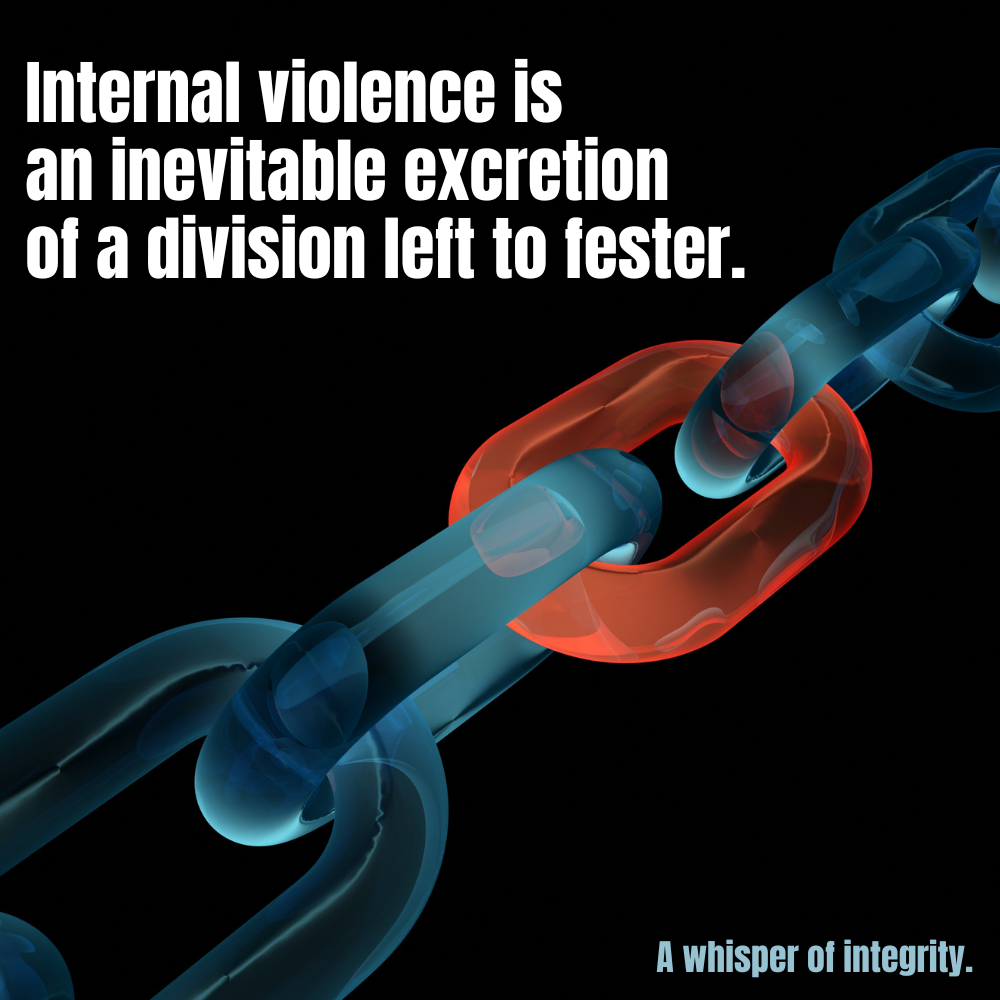
Internal violence is an inevitable excretion of a division left to fester.
Internal violence is an inevitable excretion of a division left to fester.
I can still picture the tweezers my mom kept for splinters. The gentle pressure she applied around the spot. “Sit still,” she would remind me. Then carefully, slowly and intentionally, she removed what didn’t belong. I never hid a splinter from her. I knew she would lovingly take care of it. Years later, on the road, it was a different story. Not hidden. Just postponed. I’ll get to it tonight at the hotel. And if the tweezers weren’t in my attaché case, a safety pin would have to do. Or whatever else had gathered in my luggage along the trail. Usually making it worse.
Most of the splinters we carry now aren’t in our fingers. An unspoken hurt. A conversation we keep putting off. A part of ourselves we’ve set aside for later. We aren’t hiding them. We’re just too busy for them. Yet division never stays small. Left alone, it widens and then deepens … between us and within us. The surface closes over, and what doesn’t belong begins to ache. Eventually, it finds its way out. A sharp word aimed at someone who had nothing to do with it. Wounded … and wounding. Inevitable. Maybe that tender ache isn’t the enemy, though. Maybe it’s simply wholeness, refusing to allow what doesn’t belong.
For further reflection
What small thing have I been too busy to tend … that is quietly beginning to ache?
A Whisper of Wholeness
When I realize that my bias and prejudice is a drift from love ... it is much easier to free myself to open my eyes to my own blindness.
When I realize that my bias and prejudice is a drift from love ... it is much easier to free myself to open my eyes to my own blindness.
Stand at the edge of the ocean and a rip current is nearly impossible to see. It doesn't announce itself with crashing waves. Often it looks like the calmest stretch of water. Smoother. Easier. The obvious place to wade in. That's exactly what makes it dangerous. You don't feel it take hold. You're simply swimming, doing what seems reasonable, and then you look up and the shore is much farther away than you meant to go. Bias works the same way. We imagine it as something loud and obvious, something only other people are guilty of. But most bias is a quiet current. It rarely feels like prejudice from the inside. It feels like the reasonable position, the calm water, the obvious way to see things. And little by little, without ever deciding to, we drift — away from the shore, away from love, out past where we ever meant to be.
Here is what changes everything: the moment I realize I've drifted. Not that I'm a bad person, not that I've failed some moral test — simply that the current caught me, the way currents catch everyone. That realization isn't an accusation. It's a rescue. Because guilt keeps my eyes closed. It makes me defensive, and defensiveness only pulls me further out. But the moment I see the drift for what it is — a movement away from love rather than a verdict on my character — something loosens. My eyes can open. And while I couldn't see the current on my own at all, often someone else can. Standing where I couldn't stand, seeing what I couldn't see, loving me enough to call across the water. Their sight became the beginning of mine. Maybe that's what love does most quietly of all. It notices the drift we can't feel — and opens the possibility of our journey back to shore.
For further reflection
Where might I have quietly drifted from love without realizing it? Who in my life can often see the current I am temporarily blinded to?
A Whisper of Wholeness
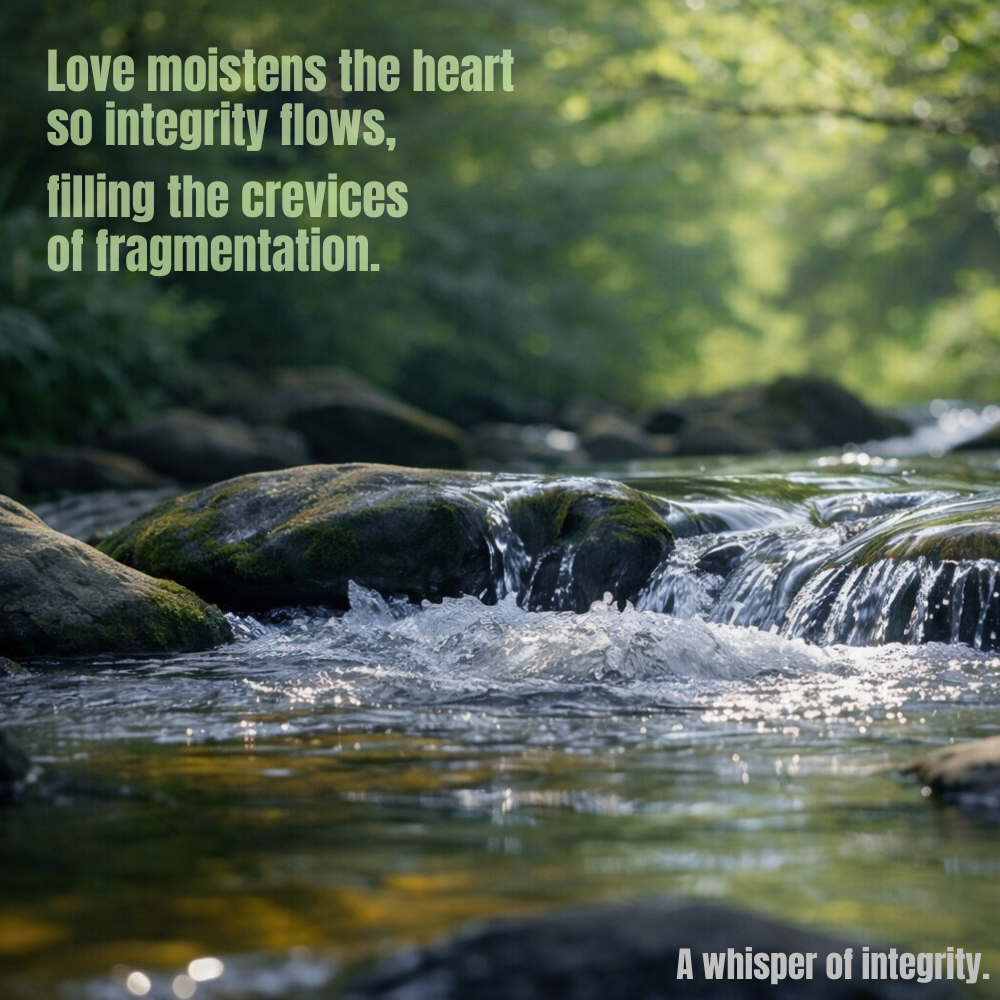
Love moistens the heart so integrity flows, filling the crevices of fragmentation.
Love moistens the heart so integrity flows, filling the crevices of fragmentation.
We keep trying to fix our fragmentation from the outside. Better arguments. Firmer boundaries. The right position, defended well enough to finally settle things. And when the cracks don't close, we assume we haven't tried hard enough. So we push harder. And the ground only splits further. But fragmentation isn't a wall someone built between us. It's what happens to ground that has gone dry. Look closely at parched earth and you'll see it — the puzzle-piece cracks, the crevices spreading in every direction. Nobody shatters the soil. It simply loses its moisture and comes apart. It’s a result —not an intention. That's the quiet truth about most of our division, within us and between us. We're not broken so much as we've dried out. Stuck. And you cannot argue moisture back into cracked ground.
Which is why this whisper doesn't begin with integrity. It begins with love. Love comes first — softening what has hardened, moistening what has gone brittle, reaching the places that certainty and effort never could. Then, and only then, does integrity flow. Not as a discipline we perform, but as something that finally moves because the ground has softened enough to receive it. Ironically, that’s all manifesting on the inside the whole while we fixate on the outside. I've spent seasons trying to hold myself together through sheer resolve, and it never once filled the crevices. What filled them was being loved in a place I'd let go dry. Hardened. Love is not the sentimental thing we've made it. It's more like water working through stone — patient, quiet, and stronger than anything it moves through. It doesn't force the cracks closed. It seeps into them until the fragmentation is no longer empty. Maybe wholeness was never about fixing what divided us. Maybe it begins the moment love reaches the ground and integrity finally has a path to flow.
For further reflection
Where in my life have I been trying to force something back together that might simply be asking to be softened first? With love.

A Whisper of Wholeness
With all the hurt in the world ... integrity weeps with empathy rather than reacting with arrogance.
With all the hurt in the world ... integrity weeps with empathy rather than reacting with arrogance.
Many have been taught to imagine integrity standing tall. Upright. Principled. Looking out over the landscape from some high, unshakable ground. And there's a quiet arrogance that can sneak into that image. It’s that sense that having integrity means having risen above the mess, above the failures, above the people still tangled in theirs. From up there, it's easy to react to the world's hurt with a shake of the head. A verdict. A tidy explanation of what those people should have done differently. But notice what this whisper says integrity actually does with all the hurt in the world. It doesn't climb higher. It weeps. And you cannot weep from a pedestal. Weeping requires you to be close enough to feel what isn't yours to feel, while caring enough for the hurt to reach you just the same.
Lately I've heard empathy described as a kind of weakness. A softness that enables, that excuses, that fails to hold the line. But I think that gets it exactly backwards. Arrogance and judgement are the easy paths. They let you stay dry and distant, tucked safely behind a verdict. Weeping is the harder, braver experience. It means refusing the protection of the high ground and choosing instead to sit down in the trench with someone where the hurt actually lives. Not in a broken world — that's too abstract to cry over. Rather in a single face. A specific name. Some of the most meaningful moments of my life have been sitting with someone in these moments. And yes, those other moments when someone sat with me. Those moments when one person is quietly coming apart and the other is seeding connection. Integrity doesn't stand over another with an answer. It sits down beside them with tears. And somewhere in that closeness — not correction, but closeness — something begins to heal.
For further reflection
Where have I encountered someone else's hurt? Did I respond by reaching for the safety of a verdict — or was I willing to come down and simply sit beside them? Where have others done this for me?

A Whisper of Wholeness
Sometimes it makes sense to slow down so your soul can catch-up.
Sometimes it makes sense to slow down so your soul can catch-up.
We rarely slow down on purpose. Speed is the language of progress, and slowing down feels like falling behind. There's always something to catch up to. The inbox. The deadline. The pace of a world that never seems to pause. And so, we keep running. Not because we chose to, but because stopping feels like something we can't afford. But here's what we rarely consider while we're running: something has been trying to catch up to us. Not the schedule. Not the expectations. Something deeper. Something that moves at a pace the world has no use for and no patience with. Your soul doesn't operate on your calendar. It moves at the speed of presence. And presence can't be rushed. The faster you go, the further behind it falls. Not because it's slow. Because it refuses to move at a pace that would cost it the only thing it values. Being. Fully. Here.
One night at our family dinner table, my parents were playfully debating who chased whom in the early days of their relationship. Back and forth they went until my dad finally said: The truth is, you chased me. Until I caught you. I loved that as a kid. I love it even more now — because that might be the most honest description of what happens when you finally slow down. Your soul has been chasing you. For years, maybe. And the moment you create enough space — enough stillness, enough pause — it catches you. Or maybe you catch it. Or maybe, like my parents, the truth is somewhere in between. Either way, the reunion only happens at a pace that makes no sense to the world. Until it makes all the sense in the world to you.
For further reflection
Where might my soul be trying to catch up to me — and all it needs is for me to slow down long enough to let it arrive?

A Whisper of Wholeness
The return to integrity is created more by what I start than what I stop. The former dissolves the need for the latter.
The return to integrity is created more by what I start than what I stop. The former dissolves the need for the latter.
So many love the language of stopping. Stop the bad habit. Break the pattern. Cut out the thing that's pulling you off course. And that language isn't wrong. It's just incomplete. Because stopping, by itself, only creates an absence. You remove something and what's left is a gap — an empty space that the old habit already knows how to fill. Willpower holds the gap open for a while. But willpower gets tired. And the gap doesn't stay empty for long. What stopped begins again on its own. What if the return to integrity isn't really about stopping at all? What if it's about starting something so alive that what needed to stop simply dissolves — not because you defeated it, but because it lost its routine luster.
Think of a garden that's been neglected. The weeds didn't arrive because you planted them. They arrived because nothing else was growing. You could spend all your energy pulling them — and you'd be exhausted and the soil would still be empty. Or you could start planting. New seeds. New attention. New life. And something remarkable happens when the garden starts to fill: the weeds lose their grounding. Not because you fought them. Because you outgrew them. The former dissolved the need for the latter. Maybe the return we keep trying to discipline ourselves into was never about what we need to stop. Maybe it's always been about what we haven't yet started. The seed is in your hand. The soil is waiting. The garden doesn't need you to pull anything. It just needs you to plant what is waiting to grow.
For further reflection
What is one thing I could start today that might naturally dissolve a pattern I've been trying to stop?

A Whisper of Wholeness
A disconnection from others is most often rooted in a disconnection from self.
A disconnection from others is most often rooted in a disconnection from self.
When a relationship starts to thin — when the conversation dries up, the trust frays, or the distance grows without anyone meaning it to — the instinct is to look outward. To fix the relationship itself. More effort. Better communication. A difficult conversation we've been avoiding. And sometimes those things help. But more often than not, they're leaves being adjusted on a plant whose roots have gone dry. The disconnection you're sensing between you and someone else may not have started between you and them at all. It may have started much closer. In the quiet gap that opened between you and yourself — a gap so familiar by now you've stopped noticing it's there.
We can't give what we don't have. That's not a limitation. It's a root system. When you're connected to your own depth — your own values, your own wholeness, the quiet center that holds you together — that connection flows outward naturally. You don't have to manufacture it. People feel it. Yet when busyness or distraction or the slow drift of daily life pulls you away from your own center, the outer connections begin to thin. Not because you stopped caring. Because the root stopped being tended. And here's what makes this both humbling and hopeful: you can't restore connection with others by working harder on the relationship. But you can restore it by returning to yourself. Tend the root, and what grows above ground has a way of finding its own way back to life. Back to connection.
For further reflection
Is there a relationship in my life that feels disconnected — and might the truest path back to that person begin with a return to myself?

A Whisper of Wholeness
Oh, that feeling of integrity after having drifted away. Just like a first day of spring!
Oh, that feeling of integrity after having drifted away. Just like a first day of spring!
Oh! There it is. That feeling you forgot you were missing. The one that doesn't announce itself with fanfare but arrives the way sunlight arrives on a morning you'd stopped expecting it. You've been away. Maybe for a while. Maybe so long that the distance stopped feeling like distance and started feeling like normal. The drift didn't happen all at once. It never does. Yet the return — it can happen in a single breath. In a moment. One moment — of honesty. One choice that lines up with something deeper than habit. And suddenly the weight you didn't know you were carrying lifts. Out of nowhere. Not because anything outside you changed. Because something inside you came home.
The first day of spring is never the one on the calendar. It's the day you step outside and feel it — that unmistakable warmth that has nothing to prove and everything to offer. A crocus pushing through soil that was frozen just last week. The air carrying something it wasn't carrying yesterday. You don't analyze spring. You receive it in the experience. And it fills you before you can think to resist it. I've drifted more times than I can count. Perhaps you have too. But what stays with me isn't the drifting. It's the feeling of return. Every single time. Realizing integrity had been waiting by the door the whole time I was gone, ready to welcome me back without a single question about where I'd been. Just warmth. Just light. Just the quiet joy of my soul recognizing that it's finally standing in its own spring. Again.
For further reflection
When was the last time I felt that unmistakable feeling of coming home to myself — and what small step might once again bring me home to it?

A Whisper of Wholeness
Integrity doesn't depend on you being correct. It depends on you realizing you are connected ... to everything and everyone.
Integrity doesn't depend on you being correct. It depends on you realizing you are connected ... to everything and everyone.
We arrive in the world without any sense of separation. No walls, no sides, no sense of where we end and everything else begins. Then slowly, necessarily, a self develops — an identity, a perspective, a way of navigating a complex world. And that self is a gift. It has to be. You can't function without it. But somewhere along the way, the self becomes the whole project. We start keeping score. Building cases. Measuring ourselves by how often we're right, how persuasively we argue, how clearly we can prove that our way of seeing is the correct one. Being correct becomes a kind of currency. A currency we spend without realizing what it's costing us. Every argument won is a connection we didn't notice. Every point proven is a bridge we walked past without crossing.
Connection was never something we needed to build. It was something we were born into and slowly forgot. Not because we're selfish. Because we got distracted. The self that was supposed to help us navigate the world began convincing us that navigating meant competing. And competing meant winning. And winning meant being correct. I've been caught in that loop more times than I'd like to admit. What I'm slowly beginning to realize is that integrity never once asked me to be right. It only ever asked me to be aware. Aware that I am a piece of something — although whole — I’m not the whole of it. My whole piece only makes sense when it remembers the greater whole. I can be correct and completely disconnected. I can also be uncertain, even wrong, and more deeply connected than I've ever been. Maybe the whole journey — the keeping score, the building cases, the needing to be right — was just the long route back to the connection I arrived with.
For further reflection
Where am I investing more energy in being right than in being connected? What might I experience if I let go of the need to win?

A Whisper of Wholeness
When we are not whole, we fragment everything. Yet wholeness is always waiting within for the opportunity to grow. Again.
When we are not whole, we fragment everything. Yet wholeness is always waiting within for the opportunity to grow. Again.
There's something about fragmentation that doesn't stay contained. It moves outward. When something inside us is fractured — unresolved, disconnected, out of alignment — we don't just carry it privately. We bring it into every room, every conversation, every decision. We fragment our relationships by showing up as pieces instead of a whole person. We fragment our seeing by projecting our own cracks onto what's in front of us. And most of the time, we don't even realize it's happening. We look at a fractured situation and assume the fractures started out there. It rarely occurs to us that what we're seeing might be a reflection of what we're carrying. What I am becomes what I create. Quietly. Systemically. In every direction. On every level.
But here's what still amazes me about wholeness: it doesn't leave. No matter how many times I've fragmented things around me — relationships, decisions, my own sense of direction — wholeness has never once packed up and moved on. It stays. Within. Waiting. Not with arms crossed and a lesson to deliver, but with the kind of patience that only something unconditional can sustain. I've walked away from my own wholeness more times than I can count, and every single time I've turned back, it was still there. Not diminished. Not resentful. Always ready. That word at the end of this whisper — again — might be the most grace-filled word in the entire thought. It means there's no limit to the invitation. Wholeness doesn't keep score. It just keeps the light on. Again. And again. And again.
For further reflection
What is one area of my life where the fragmentation I see around me might actually be a reflection of something unresolved within me? What would it look like to turn toward wholeness again?

A Whisper of Wholeness
Integrity doesn't lead you away from suffering. It carries you through it.
Integrity doesn't lead you away from suffering. It carries you through it.
Suffering can feel like an escape room. The moment you're inside it, every instinct starts searching for clues. The right conversation. The right decision. The right prayer. Or the right anything that might unlock the door and let you out. You test every wall. You try every combination. And some of the clues even seem to work for a moment — a brief relief, a flash of hope — before the walls close back in and you realize you're still inside. The harder you search for the way out, the more the room shrinks around you. This sensation of claustrophobia can turn suffering into suffocation. What no one tells you about this particular room is that it isn't an escape room at all. It's a corridor. There's no hidden exit. There's only the other end. And the only way to reach it is through it.
Maybe that's why integrity never promised to remove the suffering. It promised to carry you through it. And there's a difference between those two things that you can only understand from the inside. Being rescued means the suffering was the enemy … something to defeat, to outsmart, to leave behind as quickly as possible. Being carried through means the suffering is a passage. Not a place to stay, but not a place to flee either. A stretch of road you can't skip and weren't meant to walk alone. I haven't always trusted that. In my loneliest seasons, integrity felt more like a word — an idea — than a presence. Yet looking back, I can see it was there — beneath me, holding the ground, carrying me one step at a time through what I couldn't have carried myself. It didn't take the suffering away. It did something harder. It stayed. For me.
For further reflection
What is one season of suffering in my life that, looking back, I can now see I was carried through rather than rescued from — and what carried me?

A Whisper of Wholeness
Integrity is like golden adhesive mending and healing all that is broken.
Integrity is like golden adhesive mending and healing all that is broken.
There's an ancient Japanese art called kintsugi — the practice of repairing broken pottery with gold. Not hiding the cracks. Not discarding the pieces. Filling every fracture with something so precious that the break becomes the most beautiful part of the whole. It would be easier to throw the broken thing away. It would be faster to glue it back together and paint over the seams. But kintsugi does neither. It refuses to pretend the breaking didn't happen. And it refuses to believe the breaking is the end of the story. We tend toward the opposite ourselves. We hide the fractures. We perform wholeness while quietly falling apart inside. With an uncertain confidence, we navigate convinced that if anyone saw the cracks, they'd see someone who failed. Shame says: hide the break. Strength says: hold it together. But integrity says something else entirely.
Integrity says: let me mend that. Not fix it. Not erase it. Mend it — slowly and carefully. Making it golden. I've spent years trying to present an unbroken surface to the world, and what I've learned is that the people who've moved me most weren't the ones who appeared flawless. They were the ones who let me see their gold. Their mended places. Their healed fractures that they didn't hide but honored. There's a courage in that kind of visibility that perfection can never offer. Broken isn't wrong. It's real. And integrity doesn't ask us to be unbroken. It asks us to be willing to be mended — honestly, openly, with the kind of care that turns a crack into the most luminous thing in the room. The gold was never there to hide the damage. It was there to prove that the most beautiful wholeness has blemishes born from a brokenness willing to be healed.
For further reflection
What is one place in my life where I've been hiding a crack that might actually become something beautiful if I let it be mended instead of concealed?

A Whisper of Wholeness
The longer one goes through uncertain times ... the greater the opportunity they have to relax their grip on the illusion of certainty.
The longer one goes through uncertain times ... the greater the opportunity they have to relax their grip on the illusion of certainty.
Our first response to uncertainty is almost always to tighten. We grip harder. Perhaps reaching for plans, predictions, anything that promises to make the ground feel solid again. And that response makes sense. It's human. But it's built on an assumption we rarely examine: that certainty was never ours to hold in the first place. We gripped it so naturally, for so long, that we mistook the grip for the ground. And then the uncertain times came — and kept coming — and the grip that once felt like security slowly began to feel like exhaustion.
Something shifts when you stay in uncertainty long enough. Not because you've figured it out or made peace with it on purpose. But because duration does its own quiet work. The unfamiliar becomes less foreign. It’s like moving in a new house. It can feel like a hotel for a while, but eventually that house becomes your home. The questions that once kept you up at night begin to feel less like threats and more like companions. You don't decide to stop bracing. You just notice one day that you have. The rhythm of not-knowing has become strangely familiar — not comfortable exactly, but no longer terrifying. Almost a friend. It turns out that what I'd been gripping so tightly was never solid to begin with. Certainty was the illusion. And the longer I lived without it, the less I needed it — and the more room there was for something real to take its place. Just like home.
For further reflection
What is one uncertainty I've been enduring long enough that, if I'm honest, it might already be teaching me to need less certainty than I thought?

A Whisper of Wholeness
Like a sail ... the who I am determines the how I go.
Like a sail ... the who I am determines the how I go.
We spend a remarkable amount of energy on the how. How to lead. How to respond. How to show up in a room, a relationship, a crisis. We gather strategies, refine techniques, study what works. And none of that is wasted — knowing how matters. But there's a question underneath every how that we rarely stop long enough to ask: Who is doing the going? A sail doesn't decide where the wind will blow. It doesn't strategize its next move. What it does — all it does — is hold its shape. And because of what it is, the wind knows what to do with it. The direction was never the sail's to force. It was the sail's to receive. And then guide.
We've been taught to think of direction as something we choose and effort as something we apply. But I wonder how much of my own striving has been the work of trying to go somewhere before settling into who is making the journey. When I've gotten that reversed — when I've tried to manufacture the how without grounding it in the who — the movement feels productive but hollow. The wind is there. It's always been there. But a sail that doesn't know its own shape can't catch it. Maybe the most important work isn't deciding where to go next. It's becoming so rooted in who I am that the ever-changing winds simply add to my continuous growth.
For further reflection
What is one area of my life where I've been more focused on how to get somewhere without first settling into who is making the journey?

A Whisper of Wholeness
Integrity will never shame you ... only welcomes you just as you are.
Integrity will never shame you ... only welcomes you just as you are.
We can carry so much. Not just the weight of what we've done wrong, but the weight of believing we should have known better. Should have been further along. Should have figured this out by now. Shame loves that word — should. It builds a courtroom inside of us where we are always on trial, always falling short of some verdict we handed down on ourselves long ago. And in that courtroom, integrity starts to feel like the judge. The standard we can't meet. The bar we keep reaching for and missing. No wonder so many of us avoid the deeper work. Who wants to dig toward something that only confirms how far I've drifted?
But what if integrity was never the judge? What if it was always the one standing at the door you've been afraid to open — not with a scorecard, but with a welcome? Shame insists you clean yourself up before you come home. Integrity says come home and the rest will take care of itself. There is a version of me that believes I have to earn my way back to wholeness. And there is a truer version that knows wholeness never left. It has been here this whole time — not waiting for me to be better, but waiting for me to stop believing I had to be. The deepest act of integrity may not be getting it right. It may simply be letting myself be found exactly where I am.
For further reflection
What is one place in my life where shame has been standing guard — and what might integrity actually be whispering from the other side of that door?

A Whisper of Wholeness
Integrity doesn’t cast judgment on our drift … only an endless invitation for us to return home.
Integrity doesn’t cast judgment on our drift … only an endless invitation for us to return home.
So much of what passes for “integrity” in our culture is a courtroom. A verdict. A label. We either fear being measured by it — or we use it to measure others. And the strange part is that both responses keep us stuck in the same fractured place: a self trying to manage how it appears, rather than a soul learning how to return.
The deeper essence of integrity isn’t condemnation. It’s remembering. It’s wholeness calling us back from the subtle drift that happens in a thousand ordinary moments — when we trade presence for performance, connection for control, truth for being right. Simply, calling us back. Not with shame. Not with scolding. Just with a quiet, unwavering invitation: come back.
For further reflection
Where in my life right now do I sense drift — without needing to defend it, explain it, or judge it? And what might “returning home” look like today — in one small, real step?