
More than a blog. It’s a practice.
What are the Whispers and Echoes?
In a world that moves fast and measures everything, these gentle reminders invite you to pause. They point you inward — toward what truly matters, what can't be quantified, what calls you home to wholeness.
Visit here each weekday to read the latest whisper or conveniently receive them in your email inbox with a complimentary subscription. You can subscribe here. You can invite friends to join in this practice by sharing this link with them: JohnBlumberg.com/NEXT
A Whisper of Wholeness
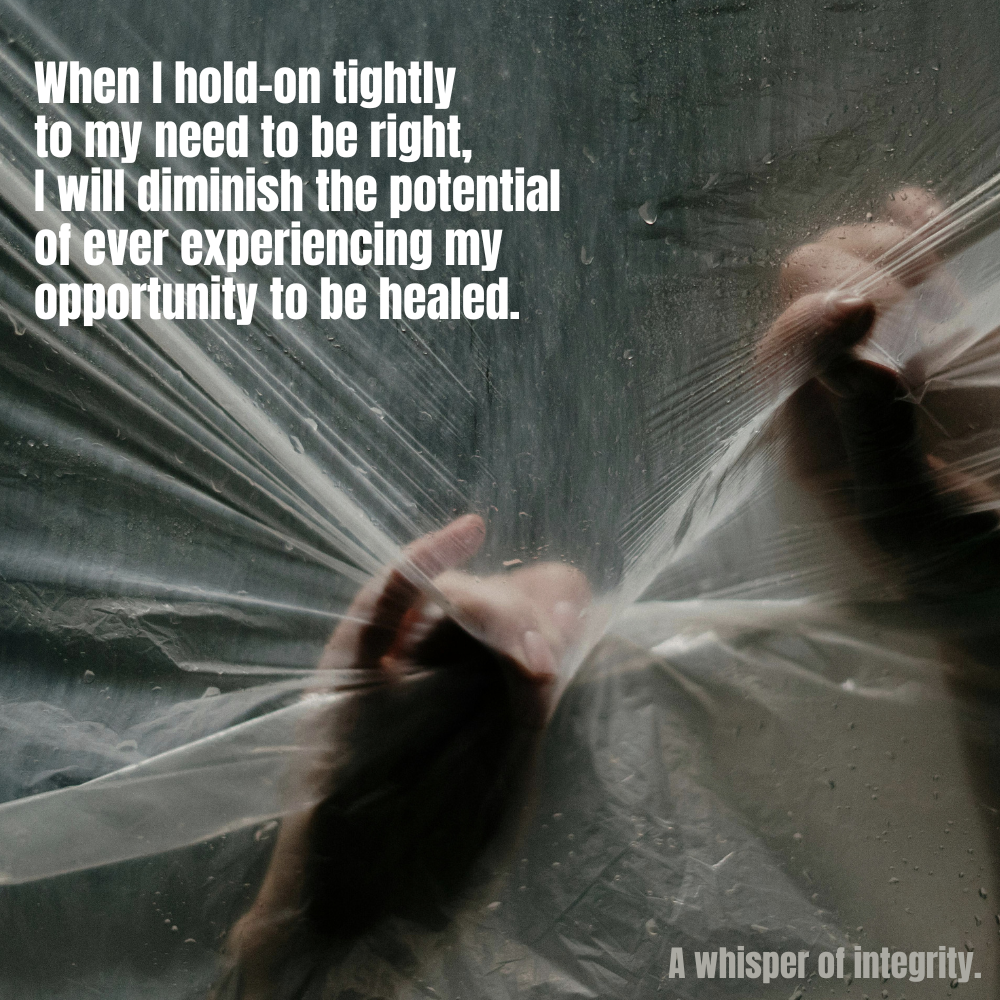
When I hold-on tightly to my need to be right, I will diminish the potential of ever experiencing my opportunity to be healed.
When I hold-on tightly to my need to be right, I will diminish the potential of ever experiencing my opportunity to be healed.
Fifty-five minutes of every hour. Face down. For two weeks. The days became long, yet that is what healing was asking of me after surgery to repair a detached retina. Vision returns slowly as a retina heals. Painfully slow. And with each passing hour, I just wanted it to be right. Right then. Right in the way I had pictured it. Face down was hardest in the day. Years later, it would all happen again. Yet, not in the same way, as I thought not again! This time it was face up where I learned the night has its own hard hours. Yet both got easier the moment I stopped asking everything to be right.
Most of us carry a quiet belief that if we could just rearrange things, they would finally be right. A different conversation. A different season. A different posture. Every arrangement has its own hard hours. Wanting it to be right doesn't take the first pain away. It adds a second one on top of it. The resistance. The gripping. Missing the very hour where healing happens. It doesn't wait for us in the future we keep wishing for. It only meets us in the hour we are actually in. Healing can't be gripped. It can only be received … and then experienced. Somewhere along the way, something shifts. Nothing is right yet … and somehow, you are all right.
For further reflection
What is one thing in my life I keep asking to be right … and what might begin to heal if I let it be what it is?

A Whisper of Wholeness
Integrity guides with gentle grace. Not harsh judgment.
Integrity guides with gentle grace. Not harsh judgment.
Picture a river after a heavy spring rain. The current runs fast and strong, and in the middle of it you are clinging to a rock with everything you have. Knuckles white. Arms burning. From the inside, the river feels like the enemy — relentless, trying to tear you loose. But the river isn't punishing you. It's simply moving toward everything waiting downstream. The pain isn't coming from the current. It's coming from the grip. We tend to imagine integrity as the harsh one. The stern inner voice keeping score. The judge who notices every way we've fallen short. So we brace against it, gripping whatever feels solid. A position, a habit, an old version of ourselves — and call the ache proof that integrity is hard. Demanding.
Yet integrity doesn't sound like that. It never has. That harsh voice is usually something else wearing integrity's clothes. The ego, keeping its ledger and demanding a performance. Integrity guides. It walks beside you. It points toward what's ahead without ever shoving you there. And its gentleness isn't weakness or permission. It's strength is patient enough to be trusted. Harshness only tightens the hands. Fear grips harder. Shame clings to the rock. The only thing that has ever loosened my fingers is a voice gentle enough to make letting go feel safe. You cannot be shamed into wholeness. You can only be guided there. Grace doesn't calm the river. It reminds you that you were never meant to fight it — and that there is more waiting. Just not here. Downstream where integrity takes you.
For further reflection
What am I clinging to right now because a harsh voice told me to hold on — and what might a gentler voice be inviting me to release?
A Whisper of Wholeness
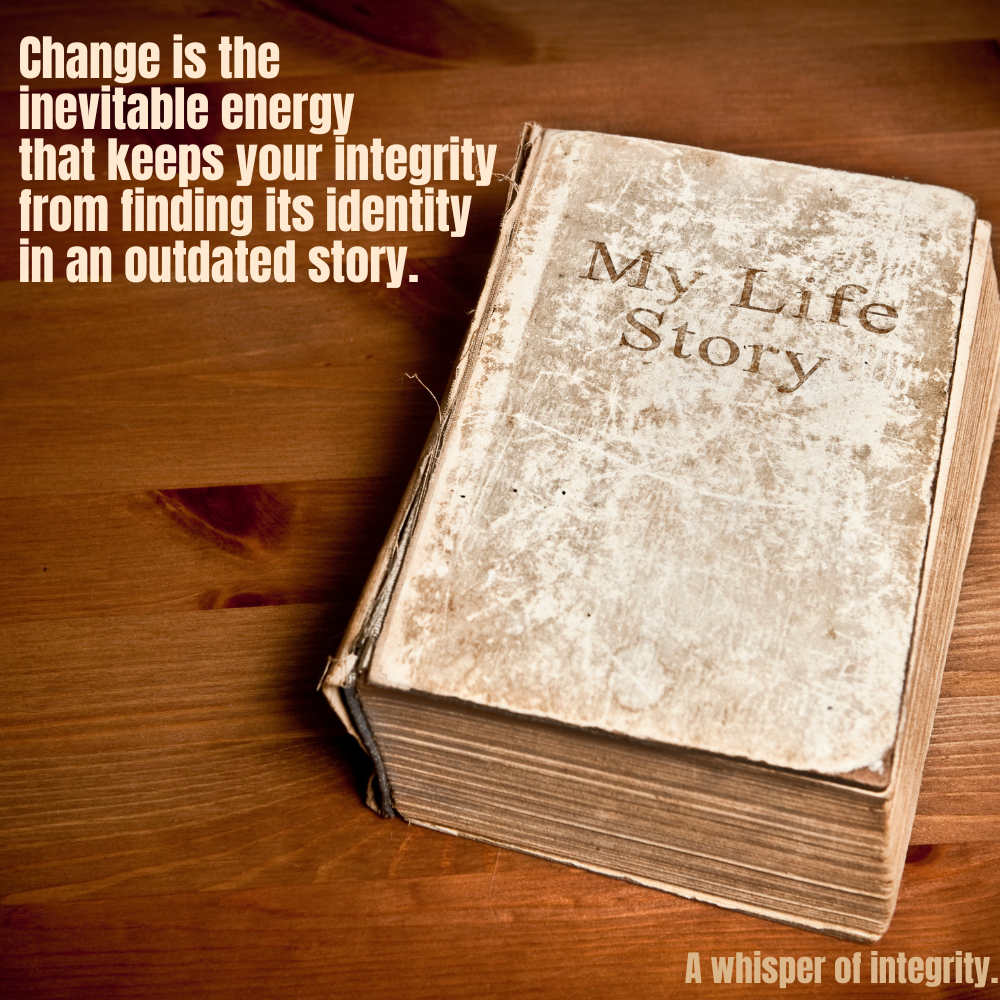
Change is the inevitable energy that keeps your integrity from finding its identity in an outdated story.
Change is the inevitable energy that keeps your integrity from finding its identity in an outdated story.
Hold a kaleidoscope to the light and something quietly astonishing happens. The same small pieces of glass — nothing added, nothing taken away — form a pattern so beautiful you want to keep it forever. So you stop turning. You hold it perfectly still, determined to preserve the very thing that moved you. And in that instant, you close the door to all else that is possible. All else that is left to learn. All else that continues to transform you beyond a present experience. A kaleidoscope held-still isn't a kaleidoscope anymore. It's just a tube with some colored glass stuck at the bottom. The beauty was never in the pattern. It was in the turning. This is the tender trap we fall into with our own integrity. We meet it once in a moment that is real, luminous, and true — in some particular season, in one particular form. And we try to hold that encounter still. We build a story around it: this is who I am, this is what my integrity looks like. The story was true. Then. But the light keeps moving, and we're still clutching a pattern which reality has continued past.
Here's the irony we rarely realize: the clutching is the drift. We think staying the same is how we stay true. But change is inevitable. It's the very energy of being alive — and when everything around us keeps turning while we refuse to, our fixed position slowly stops meaning what it meant when we took it. We don’t move, and somehow we drift anyway. I've caught myself defending an old version of who I was, mistaking the defense for integrity, when really I was just trying to keep my kaleidoscope from turning. Keeping things comfortable and familiar. The old story deserves gratitude. It showed me something real. But integrity was never meant to be a museum constructed around a single beautiful moment. It's a living essence of transformation that wants to keep turning toward the next formation of beauty. Change doesn't threaten your integrity. It's what keeps it from quietly turning to stone.
For further reflection
What story about myself have I been holding perfectly still? What new beauty might be waiting inside if I let my kaleidoscope turn again?

A Whisper of Wholeness
It is often one's attachments that cause the greatest drift. They are very glad to take you ... exactly where they need you.
It is often one's attachments that cause the greatest drift. They are very glad to take you ... exactly where they need you.
There's a ride at many amusement parks that spins so fast it pins you to the wall. The floor drops feet below without a problem. Because you can't move. You can barely breathe. And the strangest part — you're laughing. It feels like freedom. It feels like living. But you're not going anywhere. You're pinned in place by a force you volunteered for, spinning in circles. Attachments work the same way. They don't drag you kicking and screaming. Especially the most cunning ones. They invite you on — with a thrill, a promise, a sense of purpose that feels too good to question. A title. A lifestyle. A version of success that everyone applauds. You hold on because it feels right. Because it feels earned. And somewhere in the spinning, you stop noticing that you're no longer choosing the direction. You are just along for the ride.
That's the nature of attachment. It doesn't feel like drifting because it feels so intentional. You chose this. You worked for this. You deserve this. And yet this whisper says something unsettling: your attachments are very glad to take you exactly where they need you. Not where you need you. But where they need you. The attachment has its own destination, and it needs you along for the ride to keep itself alive. I've been pinned to that wall more times than I'd like to admit — spinning in something that felt like purpose but was actually just momentum without a meaningful destination. The hardest attachments to release aren't the ones that feel wrong. They're the ones that still feel right. Maybe the first step off the ride isn't letting go of something bad. It's being honest about whether something that feels good is actually taking you somewhere real.
For further reflection
What is one attachment in my life that still feels good — but might be taking me exactly where it needs me instead of where I'm meant to go?

A Whisper of Wholeness
Integrity is an essence flowing from deep within … unless, of course, I choose to interrupt it for a perceived convenience.
Integrity is an essence flowing from deep within … unless, of course, I choose to interrupt it for a perceived convenience.
There's a flow within you that knows exactly where it's going. It doesn't need instructions. It doesn't need permission. Left uninterrupted, it moves through your decisions, your relationships, your way of being in the world with a kind of quiet intelligence that no strategy could replicate. You've felt it — those stretches when everything aligns, when your actions and your essence are moving in the same current. That's not performance. That's flow. The problem is rarely that the flow isn't there. The problem is how easily you can interrupt it. And how reasonable the interruption always seems. A shortcut here. A compromise there. A small adjustment to keep things moving, to meet the deadline, to avoid the discomfort of staying in the current when the current asks more of you than the moment feels worth. The interruption rarely announces itself as a betrayal. It shows up dressed as practicality.
That's the nature of a perceived convenience — it looks like wisdom until you notice what it cost. Not now. Later. You trade the flow for the fix. The essence for the efficient. And you probably didn't even feel it happen, because the interruption was small and the convenience was immediate. You got distracted. But the flow noticed. It always does. Every interruption leaves a gap — not dramatic, not catastrophic, just a quiet thinning of something that was full a moment before. The accumulation of those small gaps is the drift we never meant to take. Maybe the most honest question isn't whether integrity is flowing within you. It almost certainly is. The question is how often you're choosing — moment by moment, convenience by convenience — to step on the hose.
For further reflection
What is one small convenience I keep choosing that might be quietly interrupting something deeper trying to flow through me?

A Whisper of Wholeness
The essence of integrity manifests itself in a paradoxical dance of the deep desire for connection without any need of ever holding-on.
The essence of integrity manifests itself in a paradoxical dance of the deep desire for connection without any need of ever holding-on.
We've been taught that desire and letting go can't occupy the same space. If you want something deeply, you hold it tightly. If you're not holding it, you must not care. And so we grip — relationships, outcomes, people, even our own sense of who we are. We grasp convinced that the strength of our hold is the measure of our devotion. But there's a kind of connection that works nothing like a grip. It works like a dance. Two people moving toward each other and away again, trusting the space between them as much as the closeness. A great dancer never clutches. The moment you grip, the movement dies. Beauty was never in the holding. It was in the rhythm of reaching and releasing — and trusting that the return is already written into the music.
That trust is the paradox. Not less desire. More. A desire so deep it doesn't need to grip because it already knows the connection isn't held in place by force. It's held by essence. I've learned this the slow way. I've gripped relationships until they couldn't breathe. I've clutched outcomes until the life drained out of them. And what I'm discovering is that the connections that endure aren't the ones I held the tightest. They're the ones I trusted enough to let move. To let breathe. To let dance. Connection doesn't depend on proximity or possession. It lives in something deeper — something that remains even when the music pauses or the distance grows. The dance continues. Even in the space between.
For further reflection
What is one connection in my life that I've been gripping — and what might come alive if I trusted it enough to let it dance?

A Whisper of Wholeness
The hardest part of healing may be letting go of how fast we want it to happen.
The hardest part of healing may be letting go of how fast we want it to happen.
We can endure a lot. The pain of what broke. The fear of what's uncertain. The disorientation of finding ourselves in a place we never planned to be. These are hard, but they're not the hardest. The hardest part is the pace. Healing doesn't move at the speed of our preference, and something in me refuses to accept that. I want the timeline. The trajectory. Some visible evidence that I’m getting better on schedule. And when the healing takes longer than I think it should — when it spirals or stalls or starts over entirely — I don't just feel frustrated. I feel failed. As if the slowness itself is proof that something has gone wrong. But maybe the slowness isn't going wrong. Maybe it's going deep.
There's a word hiding inside the word "patient" that we tend to overlook: patience. To be a patient is to practice patience — not as a virtue you choose, but as a condition you inhabit. I've learned this more than once. Each time life has asked me to heal, the lesson has come from a different depth — not because the healing was the same, but because I was in a different season of my life each time. And each time, I had to start over. Not from scratch exactly, but from a new beginning that didn't care how many times I'd sat in this classroom before. What I'm learning is that my urgency to heal faster doesn't speed the healing. It interferes with it. The mending has its own pace, and that pace knows something I don't. Letting go of how fast I want it to happen might be the first thing that actually needs to heal.
For further reflection
Where am I rushing a healing in my life right now — and what might shift if I honored the pace instead of fighting it?

A Whisper of Wholeness
So easy it can be to drift from anticipation to expectation. It's a drift that empties the soul of the gift.
Tightly holding onto an old way of thinking is precisely what prevents one from a new way of seeing.
Anticipation is one of the most alive experiences we can feel. It doesn't know what's coming — and that not-knowing is the gift within the gift. There's a fullness in waiting when your hands are open. A quiet energy. A leaning-forward that has nothing to prove and everything to receive. But somewhere along the way — so subtly we don't notice — the anticipation begins to harden. "I wonder what will come" becomes "I know what should come." The open hands begin to close. Not into fists exactly, but into something with a shape — a picture of what the gift should look like. When it should arrive. How it should feel. And the moment we hold that picture, we've stopped receiving the gift. We've started grading it.
That's the drift. Not from something good to something bad. Yet from something alive to something measured. Expectation isn't evil. It's just anticipation with the wonder removed. The box without the gift inside. I've watched it happen in my own life more times than I'd like to admit. The slow slide from hope to assumption — from gratitude to audit. A relationship that once filled me with wonder quietly became something I monitored for performance. A calling that once stirred awe slowly became a career I managed for outcomes. The gift was still there. But I had emptied the soul of it by deciding in advance what I expected from it. Maybe the most generous thing I can do — for the gift and for myself — is to keep my hands open long enough to simply be surprised by what arrives.
For further reflection
Where in my life has my anticipation quietly hardened into expectation — and what gift might I be missing because I've already decided what it should look like?

A Whisper of Wholeness
Tightly holding onto an old way of thinking is precisely what prevents one from a new way of seeing.
Tightly holding onto an old way of thinking is precisely what prevents one from a new way of seeing.
We don't hold onto an old way of thinking because it has failed us. We hold onto it because it worked. It gave us language for things we couldn't name, a framework for complexity we couldn't navigate, clarity when everything felt uncertain. We're grateful. And we should be. But gratitude can quietly become a cage when it turns into permanence. The insight that was meant to carry us through a season can become the lens we use for every season after. Even when the landscape has completely changed. We're not holding on because we're stubborn. We're holding on because letting go of something that once served us so well feels like dishonoring it. But here's what I'm beginning to understand: nothing dishonors a great insight more than refusing to outgrow it.
There's a difference between thinking and seeing that most of us never notice — because thinking is so much louder. Thinking organizes, defends, categorizes. It builds a map and then insists the territory match. Seeing does something else entirely. It takes in what's actually there before the mind can sort it. It lets the territory reveal itself — even when it contradicts the map. I've carried maps that served me beautifully for years, only to realize they were keeping me from seeing what was actually in front of me. The old thinking wasn't wrong. It is finished. And a new way of seeing couldn't arrive until I set the old thinking down. Unlearning isn't forgetting. It isn't betrayal. It's the deepest form of honoring what something taught you — by trusting that it prepared you for whatever comes next. Even if, for now, what comes next can only be seen, not thought.
For further reflection
What is one way of thinking that served me well in an earlier season but might now be standing between me and a new way of seeing?

A Whisper of Wholeness
Integrity doesn't equip you with certainty. It enables you to flourish amidst uncertainty.
Integrity doesn't equip you with certainty. It enables you to flourish amidst uncertainty.
There's an expectation we rarely say out loud: that the deeper we go into our own integrity, the more certain things will become. That the inner work will eventually deliver clarity. A firm foundation. A clear direction. Or at least a confidence that settles the questions once and for all. And when certainty doesn't arrive, it can feel like something has gone wrong. Like the work didn't take. But what if certainty was never what integrity was offering? What if we've been measuring the gift by the wrong standard? I’m waiting for solid ground when what I was actually being given was the ability to move beautifully on ground that never stops shifting?
There's a difference between being equipped and being enabled. Equipped means someone handed me the right tools for a known situation. It works — until the situation changes and the tools don't fit anymore. Enabled means something in me has been awakened that doesn't depend on the situation at all. I've chased certainty for most of my life. I wanted integrity to be the thing that finally made me sure. What I'm discovering is that it made me something better than sure. It made me capable of flourishing without being sure. That's not a consolation prize. It's the real one. A tree doesn't flourish because the weather is predictable. It flourishes because its roots go deep enough to hold it through whatever weather comes. Uncertain. And flourishing.
For further reflection
Where in my life am I still waiting for certainty before I let myself flourish — and what if the flourishing doesn't need the certainty at all?

A Whisper of Wholeness
The longer one goes through uncertain times ... the greater the opportunity they have to relax their grip on the illusion of certainty.
The longer one goes through uncertain times ... the greater the opportunity they have to relax their grip on the illusion of certainty.
Our first response to uncertainty is almost always to tighten. We grip harder. Perhaps reaching for plans, predictions, anything that promises to make the ground feel solid again. And that response makes sense. It's human. But it's built on an assumption we rarely examine: that certainty was never ours to hold in the first place. We gripped it so naturally, for so long, that we mistook the grip for the ground. And then the uncertain times came — and kept coming — and the grip that once felt like security slowly began to feel like exhaustion.
Something shifts when you stay in uncertainty long enough. Not because you've figured it out or made peace with it on purpose. But because duration does its own quiet work. The unfamiliar becomes less foreign. It’s like moving in a new house. It can feel like a hotel for a while, but eventually that house becomes your home. The questions that once kept you up at night begin to feel less like threats and more like companions. You don't decide to stop bracing. You just notice one day that you have. The rhythm of not-knowing has become strangely familiar — not comfortable exactly, but no longer terrifying. Almost a friend. It turns out that what I'd been gripping so tightly was never solid to begin with. Certainty was the illusion. And the longer I lived without it, the less I needed it — and the more room there was for something real to take its place. Just like home.
For further reflection
What is one uncertainty I've been enduring long enough that, if I'm honest, it might already be teaching me to need less certainty than I thought?

A Whisper of Wholeness
The essence of integrity is often experienced not by what you are willing to hold onto, but by what you are willing to let go of.
The essence of integrity is often experienced not by what you are willing to hold onto, but by what you are willing to let go of.
We've been taught that integrity means holding firm. Standing your ground. Gripping tightly to what you believe and not letting go — no matter what. And there's something in that image that feels right. Noble, even. But somewhere along the way, the grip itself can become the thing we're most committed to. Not what we're holding — just the holding. A viewpoint that once opened a door quietly becomes the wall. A stance that once created connection begins to divide without our noticing. We hold tighter, convinced that the tightness is the proof of our integrity. But what if the tightness is precisely where the drift begins?
Letting go isn't giving up. It isn't weakness, and it isn't surrender to whatever wind blows through. It's something far harder — the willingness to examine what's in your hands and ask whether it still serves wholeness or whether you've been gripping it out of habit, out of fear, out of the comfort of certainty. Perhaps control. I've held things tightly that I was sure defined me — only to discover I was holding them while seeing unclearly. The moment I loosened my grip wasn't the moment I lost my integrity. It was the moment I found more of it. Sometimes the most courageous thing integrity asks of you isn't to hold on. It's to open your hands — and trust what remains.
For further reflection
What is one belief, expectation, or perspective I'm gripping tightly right now that might be worth holding with more open hands?

A Whisper of Wholeness
In silence the mask falls. Slowly.
In silence the mask falls. Slowly.
We all wear them. Not out of dishonesty — out of habit. Layer by layer, we've assembled a version of ourselves that knows what to say, how to show up, what face to wear in which room. Some of these layers were chosen. Others just accumulated — a response here, a performance there, a posture we held so long it began to feel like skin. We don't usually think of it as a mask. It just feels like getting through the day. And in the noise of all that getting-through, the mask stays perfectly in place. It has to. The noise keeps it there.
But silence does something that nothing else can. It stops holding the mask in place. Not all at once — there's no dramatic unveiling, no sudden moment of exposure. Just a slow release, like something loosening that you didn't know was tight. The first time I sat long enough in real silence, I didn't discover some hidden truth. I just noticed how much effort I'd been spending to keep everything in place. That noticing was the beginning. Silence doesn't rip anything away. It simply makes it safe enough for what is real to outlast what is performed. And as the beauty reveals itself, you realize what falls away was never yours to begin with.
For further reflection
If I sat in ten minutes of complete silence today — no agenda, no task, no noise — what might I notice about what I've been holding in place?

A Whisper of Wholeness
Integrity thrives amongst awe and wonder ... yet suffocates in a harness of power and control.
Integrity thrives amongst awe and wonder ... yet suffocates in a harness of power and control.
We rarely notice the climate we've created inside ourselves. There's an interior atmosphere — a kind of weather system of the soul — that determines what can grow and what quietly dies. We build structures of understanding, accumulate expertise, develop strategies for managing our lives, and somewhere along the way that competence begins to harden into certainty. We stop wondering and start knowing. We stop noticing and start managing. It feels like strength. It even looks like it. But integrity doesn't thrive in a controlled environment. It needs air. It needs the kind of air that only comes when we're willing to be astonished by something we can't explain.
Power and control aren't always loud. Sometimes they show up as the quiet insistence that we already understand enough. That we've already arrived. That the next question has an answer we can predict. I've felt that harness tighten around my own thinking — the pull toward certainty that slowly squeezes out the room for surprise. And what surprises me most is how natural the harness feels once it's in place. There is a comfort. A confidence. You don't feel it closing. Until you notice when something inside you stops breathing. Awe can't be manufactured or scheduled. But it can be welcomed — the moment we take a deep breath, loosen the grip just enough to let the wonder back in.
For further reflection
Where in my life right now has my need to understand or control something quietly squeezed out the room for wonder?

A Whisper of Wholeness
Inflection points of a deeper transformation never come in times of success, power or control. They come in the times we would never choose.
Inflection points of a deeper transformation never come in times of success, power or control. They come in the times we would never choose.
We plan for personal growth the way we plan for everything — as if it's something we can schedule. We invest in the right experiences, read the right books, surround ourselves with the right influences, and expect that transformation will arrive on time and well-organized. And sometimes transformation does … or at least something that looks like it. Yet the shifts that rearrange us at the deepest level, the ones that change not just what we know but from where we see — those rarely show up when we're standing on solid ground. They most often show up when our ground gives way.
There's something in us that keeps waiting to be ready. To feel strong enough, clear enough, settled enough to take the next step deeper. But I don't think transformation waits for readiness. It moves in the moments we would never design — the loss, the failure, the season that makes no sense. Not because suffering has some hidden virtue, but because it's in the unchosen moments that our grip finally loosens on everything we thought we needed to hold. And in that loosening, something truer has room to arrive. The times we would never choose may be precisely the times that care enough to choose us.
For further reflection
What is one unchosen experience in my life that, looking back, quietly changed something deeper in me than any success ever did?

A Whisper of Wholeness
When I'm so busy insisting on how things should be I most often miss out on how beautiful they actually are.
When I'm so busy insisting on how things should be I most often miss out on how beautiful they actually are.
We're taught to see clearly — to assess, to measure, to know exactly where things stand. And somewhere along the way, that clarity becomes a kind of insistence. We develop sharp pictures of how our work should unfold, how people should respond, how progress should look. The sharper the picture, the more productive we feel. But there's a quiet cost to all that certainty. The tighter we grip our version of how things should be, the less we're able to see what is actually unfolding right in front of us. Confidence in our own clarity can become the very thing that blinds us.
Beauty rarely arrives on schedule. It doesn't match the plan or check the expected boxes. It shows up in the unscripted moment — the conversation that veered off-agenda, the outcome that looks nothing like what I mapped out, the ordinary Tuesday that suddenly holds something I almost walked right past. I wonder how many times I've been so certain about what I was looking for that I missed what was being offered. Maybe the most productive thing I could do today is loosen my grip on what should be — just enough to notice what already is.
For further reflection
What is one expectation I'm holding so tightly right now that it might be keeping me from seeing something beautiful?

A Whisper of Wholeness
What if I stopped striving to find what I'm looking for ... and instead sat still to discover what is looking for me?
What if I stopped striving to find what I'm looking for ... and instead sat still to discover what is looking for me?
We've been trained to search. To set goals, scan the horizon, and pursue. We bring that same energy to the inner life — treating our deepest truths like objectives to be researched, identified, and checked off. And so we dig with great effort, sometimes confusing the intensity of the search with the depth of the discovery. But there's a moment (and it often catches us completely off guard) when all that striving quietly becomes the very thing standing between us and what we most want to find.
Stillness doesn't come naturally to most of us. It feels unproductive. Even risky. And yet, when I've finally stopped long enough to simply be present — not waiting for something, not enduring the pause until I can resume the search — something shifts. What I thought I was looking for was already looking for me. It has been there all along, the way stars fill a night sky whether we glance up or not. We just couldn’t see it while we were so busy searching. Perhaps the deepest discovery isn't something I achieve. It's something I allow — by finally getting still enough to be found.
For further reflection
Where in my life right now is my striving keeping me from seeing what might already be present?

A Whisper of Wholeness
You don't have integrity. Integrity holds you. The key is to relax into it. To trust it. Like floating on water.
You don't have integrity. Integrity holds you. The key is to relax into it. To trust it. Like floating on water.
We've been taught to pursue integrity as if it were something to achieve. Something to build, earn, or prove. And so we grip. We effort our way toward it. We hold ourselves to standards, measure ourselves against ideals, and when we fall short, we grip even harder. But gripping is not the same as growing. The tighter I hold, the more exhausted I become. And the more exhausted I become, the easier it is to drift — not because I stopped caring, but because I am working so hard at something that was never meant to be worked on that way.
Anyone who has floated on water knows the secret. You don't float by trying harder. You float by letting go of everything that tells you the water can't hold you. Every muscle that tenses pulls you under. Every instinct to fight the surface is the very thing that breaks it. Floating asks one thing of you. Trust what is already holding you. It doesn't require your effort. It requires your release. And in that release, something strange happens. You don't sink into nothingness. You are held by everything. Integrity works the same way. It was never something I needed to reach for. It was always what was waiting for me when I stopped reaching. Already there. Already holding. Waiting for me to exhale.
For further reflection
Where in my life am I gripping so tightly toward integrity that I might be keeping myself from the wholeness already holding me?

A Whisper of Wholeness
If only I would let go of having in order to be ... instead of letting go of being in order to have. Paradoxically, I would have so much more.
If only I would let go of having in order to be ... instead of letting go of being in order to have. Paradoxically, I would have so much more.
We've been conditioned well. Conditioned to believe that who we are emerges from what we accumulate: credentials, titles, possessions, wins. So, we let go of ourselves bit by bit, trading presence for productivity, depth for recognition, stillness for the next thing on the list. We sacrifice being on the altar of having, convinced this is just how it works. And maybe it does work. Until the day we realize we've built an impressive life around an increasingly hollow center.
But what if the flow runs backward? What if the richest having flows from our deepest being? Not having less, but having more – more aliveness, more connection, more capacity, more freedom. When we stop fragmenting ourselves to acquire and achieve, we discover we already possess what we've been chasing. We discover wholeness isn't found in the next accomplishment. It's found in releasing the grip that keeps us from it.
For further reflection
What am I holding onto – or reaching for – that keeps me from simply being present to who I already am?

A Whisper of Wholeness
Integrity doesn’t cast judgment on our drift … only an endless invitation for us to return home.
Integrity doesn’t cast judgment on our drift … only an endless invitation for us to return home.
So much of what passes for “integrity” in our culture is a courtroom. A verdict. A label. We either fear being measured by it — or we use it to measure others. And the strange part is that both responses keep us stuck in the same fractured place: a self trying to manage how it appears, rather than a soul learning how to return.
The deeper essence of integrity isn’t condemnation. It’s remembering. It’s wholeness calling us back from the subtle drift that happens in a thousand ordinary moments — when we trade presence for performance, connection for control, truth for being right. Simply, calling us back. Not with shame. Not with scolding. Just with a quiet, unwavering invitation: come back.
For further reflection
Where in my life right now do I sense drift — without needing to defend it, explain it, or judge it? And what might “returning home” look like today — in one small, real step?