
More than a blog. It’s a practice.
What are the Whispers and Echoes?
In a world that moves fast and measures everything, these gentle reminders invite you to pause. They point you inward — toward what truly matters, what can't be quantified, what calls you home to wholeness.
Visit here each weekday to read the latest whisper or conveniently receive them in your email inbox with a complimentary subscription. You can subscribe here. You can invite friends to join in this practice by sharing this link with them: JohnBlumberg.com/NEXT
A Whisper of Integrity
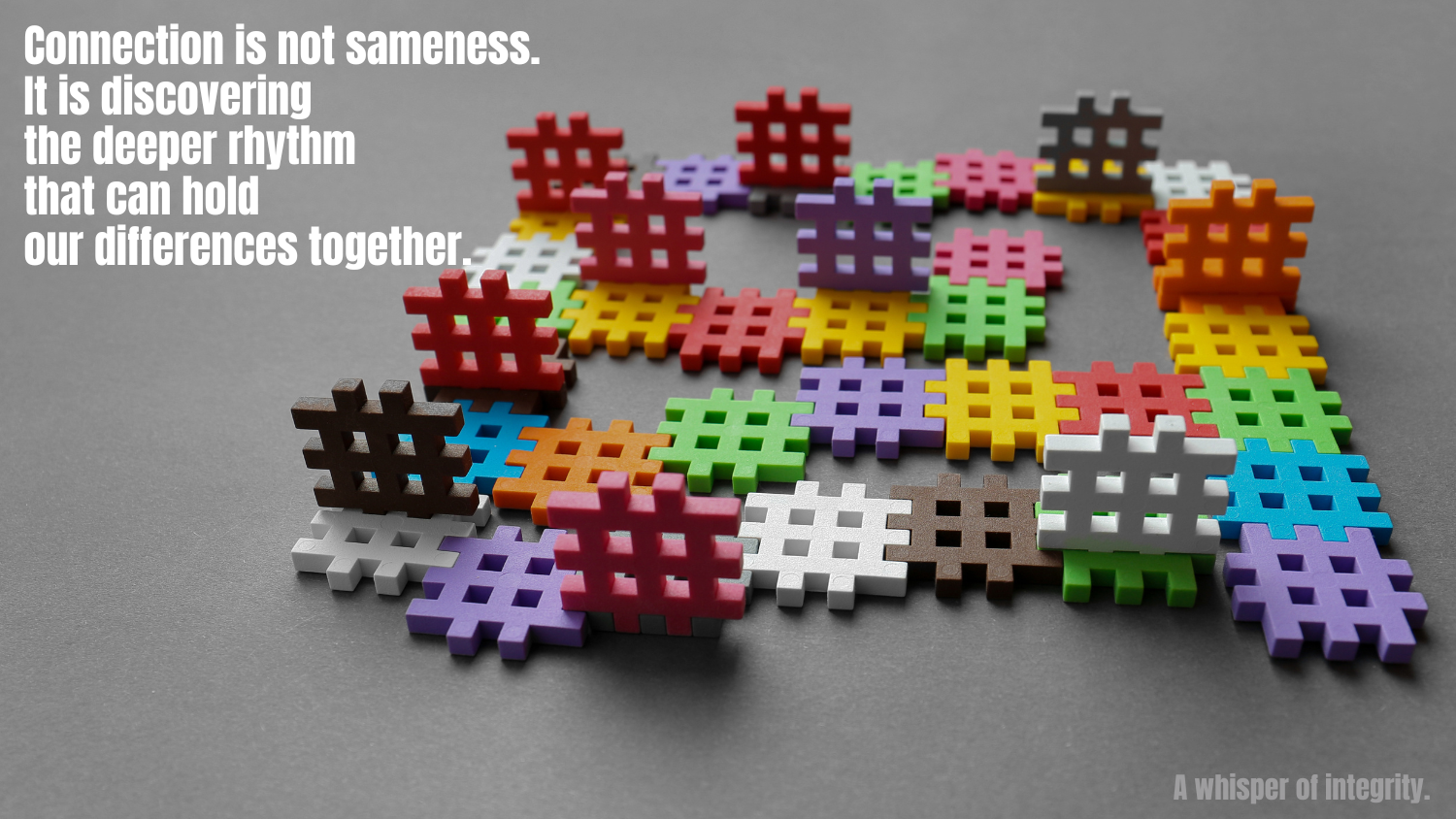
Connection is not sameness. It is discovering the deeper rhythm that can hold our differences together.
A Whisper of Wholeness
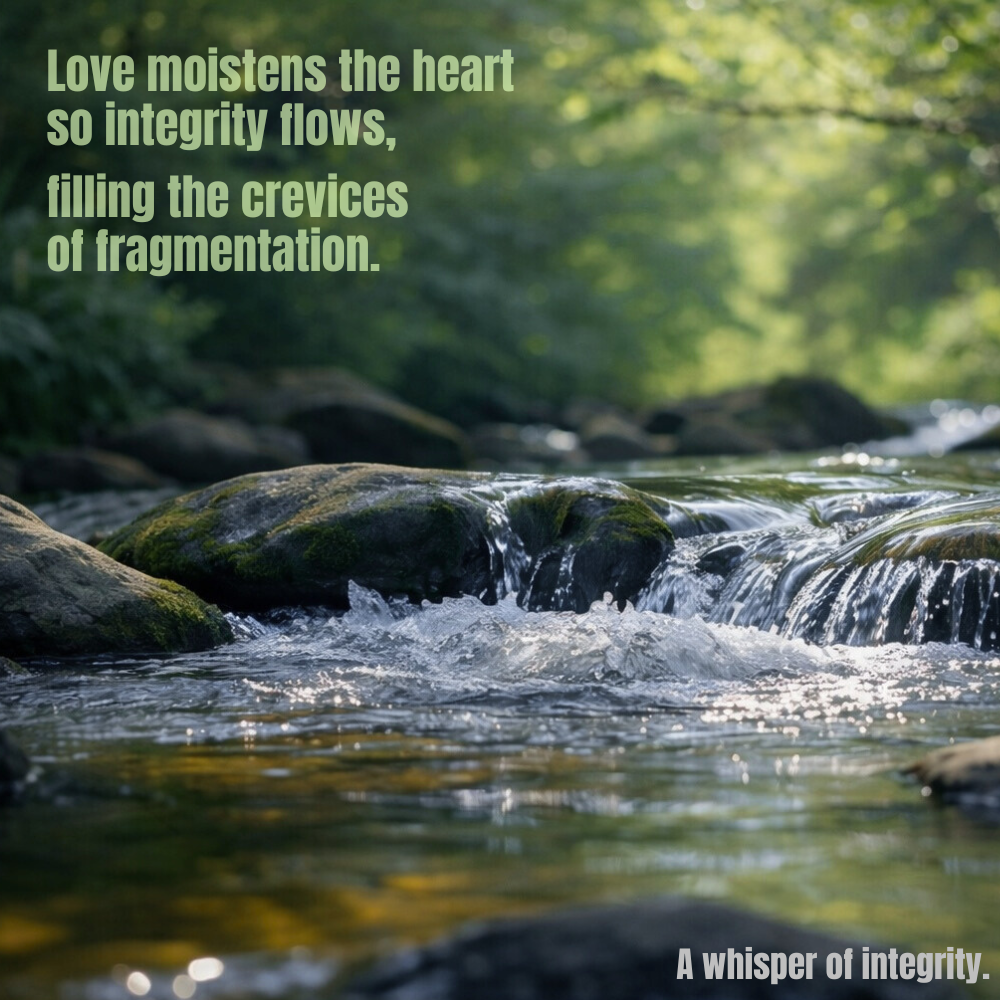
Love moistens the heart so integrity flows, filling the crevices of fragmentation.
Love moistens the heart so integrity flows, filling the crevices of fragmentation.
We keep trying to fix our fragmentation from the outside. Better arguments. Firmer boundaries. The right position, defended well enough to finally settle things. And when the cracks don't close, we assume we haven't tried hard enough. So we push harder. And the ground only splits further. But fragmentation isn't a wall someone built between us. It's what happens to ground that has gone dry. Look closely at parched earth and you'll see it — the puzzle-piece cracks, the crevices spreading in every direction. Nobody shatters the soil. It simply loses its moisture and comes apart. It’s a result —not an intention. That's the quiet truth about most of our division, within us and between us. We're not broken so much as we've dried out. Stuck. And you cannot argue moisture back into cracked ground.
Which is why this whisper doesn't begin with integrity. It begins with love. Love comes first — softening what has hardened, moistening what has gone brittle, reaching the places that certainty and effort never could. Then, and only then, does integrity flow. Not as a discipline we perform, but as something that finally moves because the ground has softened enough to receive it. Ironically, that’s all manifesting on the inside the whole while we fixate on the outside. I've spent seasons trying to hold myself together through sheer resolve, and it never once filled the crevices. What filled them was being loved in a place I'd let go dry. Hardened. Love is not the sentimental thing we've made it. It's more like water working through stone — patient, quiet, and stronger than anything it moves through. It doesn't force the cracks closed. It seeps into them until the fragmentation is no longer empty. Maybe wholeness was never about fixing what divided us. Maybe it begins the moment love reaches the ground and integrity finally has a path to flow.
For further reflection
Where in my life have I been trying to force something back together that might simply be asking to be softened first? With love.
A Whisper of Integrity
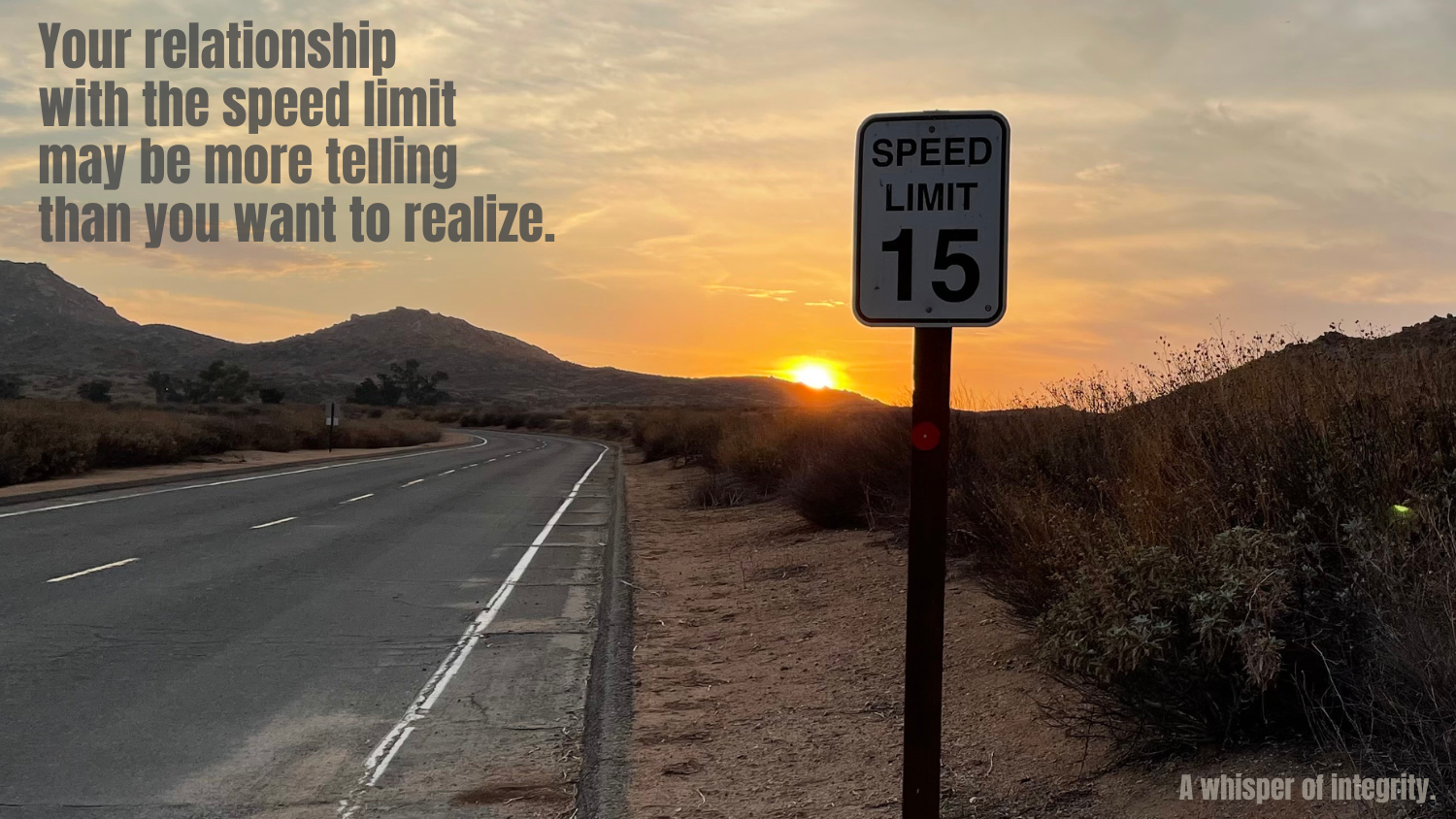
Your relationship with the speed limit may be more telling than you want to realize.
A Whisper of Wholeness
Wonder is not a way of living. It is a way of seeing.
Wonder is not a way of living. It is a way of seeing.
Two people stand at the same window as the same sun goes down. The sun and the sky do what they do. Together creating the slow bleed of orange into rose into a violet that has no name. Yet of the two people, one barely registers it. Already thinking about dinner, reaching habitually for their phone, somewhere other than here. Yet beside them, the other goes completely still. Something in the chest releases, letting go of the body, the schedule, the list — and self. Same sky. Same light. Same handful of minutes. And yet one of them witnesses a change in the time of day while the other, briefly, is undone by beauty. The sunset didn't choose between them. They chose. Or rather, something in how they were already seeing chose for them.
I once heard someone share that the deepest shift isn't in what you see. It's in where you see it from. That has stayed with me for years, because it names something we usually get backwards. We think wonder is a reward the world occasionally hands us. A spectacular view. A rare moment. Something impressive enough to break through. But wonder isn’t waiting in the sunset. It is waiting in us. It's the place we see from before our eyes land on anything at all. It is a kind of inner availability, an openness that the noise and the hurry quietly close. When I've missed the most beautiful things in my life, it was almost never because they weren't there. It was because I wasn't. Perhaps wonder isn't something we go looking for. Maybe it's what becomes possible the moment we empty ourselves enough to allow the wonder within to see what is right in front of us.
For further reflection
What ordinary thing might become extraordinary today — not because it changed, but because I finally saw it from a place of wonder?
A Whisper of Integrity
Movement without certainty may very well prove more whole than certainty without movement.
A Whisper of Integrity
In what shatters, we are reminded how deeply we belong to one another.
A Whisper of Wholeness
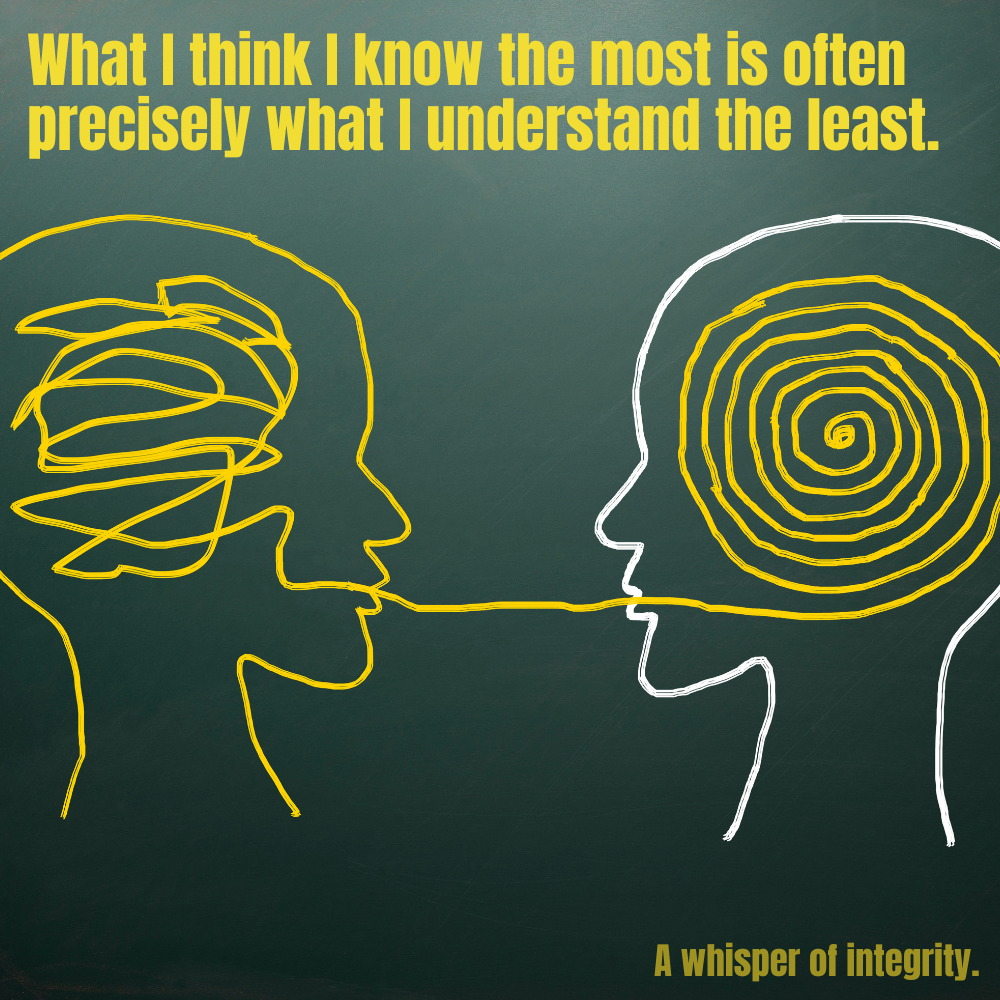
What I think I know the most is often precisely what I understand the least.
What I think I know the most is often precisely what I understand the least.
Knowing feels like arrival. The moment we're certain we know something, a quiet door closes. We stop asking about it. We stop looking at it. We file it away as settled and move on to the things we haven't figured out yet. And that seems to make sense — you can't reexamine everything all the time. But here's the trap: the things we're most certain we know are often the things we've examined the least in recent years. We've lived beside them so long that familiarity started impersonating understanding. We know the name. Yet, we’ve forgotten the face. And because we're so sure, we never think to look again. And all the while most everything has changed.
The ego loves this arrangement. Certainty feels like control. Being on top of things. Standing on solid ground. Understanding invites something far riskier. It asks you to say the most vulnerable sentence there is: I don't understand this as well as I thought I did. That sentence feels like weakness. It isn't. It's the gym where real strength gets built and the lab where every discovery is born. Nothing new was ever found on the safe shore of what we already know. From there you might observe, yet rarely discover. You must be willing to leave it — to sail out past the comfortable certainties into the open water of genuine not-knowing. And what I keep discovering, every time I'm brave enough to admit I understand less than I assumed, is that the admission isn't the end of anything. It's the beginning of everything. Maybe the deepest understanding begins with the courage to unknow and the humility to let go of what we were so sure we knew.
For further reflection
What is one thing I'm certain I know well that might be inviting me — if I have the courage — to look at it again with fresh and unknowing eyes?
A Whisper of Integrity
Integrity is not an achieved arrival. It is an awakening to wholeness right where you are.
A Whisper of Wholeness
With all the hurt in the world ... integrity weeps with empathy rather than reacting with arrogance.
With all the hurt in the world ... integrity weeps with empathy rather than reacting with arrogance.
Many have been taught to imagine integrity standing tall. Upright. Principled. Looking out over the landscape from some high, unshakable ground. And there's a quiet arrogance that can sneak into that image. It’s that sense that having integrity means having risen above the mess, above the failures, above the people still tangled in theirs. From up there, it's easy to react to the world's hurt with a shake of the head. A verdict. A tidy explanation of what those people should have done differently. But notice what this whisper says integrity actually does with all the hurt in the world. It doesn't climb higher. It weeps. And you cannot weep from a pedestal. Weeping requires you to be close enough to feel what isn't yours to feel, while caring enough for the hurt to reach you just the same.
Lately I've heard empathy described as a kind of weakness. A softness that enables, that excuses, that fails to hold the line. But I think that gets it exactly backwards. Arrogance and judgement are the easy paths. They let you stay dry and distant, tucked safely behind a verdict. Weeping is the harder, braver experience. It means refusing the protection of the high ground and choosing instead to sit down in the trench with someone where the hurt actually lives. Not in a broken world — that's too abstract to cry over. Rather in a single face. A specific name. Some of the most meaningful moments of my life have been sitting with someone in these moments. And yes, those other moments when someone sat with me. Those moments when one person is quietly coming apart and the other is seeding connection. Integrity doesn't stand over another with an answer. It sits down beside them with tears. And somewhere in that closeness — not correction, but closeness — something begins to heal.
For further reflection
Where have I encountered someone else's hurt? Did I respond by reaching for the safety of a verdict — or was I willing to come down and simply sit beside them? Where have others done this for me?
A Whisper of Integrity
My work is an expression of who I am, not a definition of who I am.

A Whisper of Wholeness
The sole pursuit of more often results in a soulless destination of less.
The sole pursuit of more often results in a soulless destination of less.
There's a word hiding inside this whisper. Move one letter and "sole" becomes "soul." That may be the smallest and most important distance in the English language. A sole pursuit — the only thing driving you — seems focused. Ambitious. Directed. But when the only direction is more, something essential quietly exits the journey. More revenue. More recognition. More impact. More reach. Even more good. Each one reasonable on its own. Each one dangerous when it becomes the sole thing you're chasing — because the pursuit of more has a way of hollowing out the very destination it promises to fill. You arrive with your arms full. And something inside you empty.
The tricky part is that “more” rarely presents itself as greed. It’s way too clever to fall for that. It looks like ambition. Drive. Purpose. It wears the clothing of goals worth pursuing and lives worth building. Few question the person pursuing more, especially when that more seems worthy. They are celebrated and frequently bestowed with recognition. But there's a question that cuts through every version of more, no matter how noble the packaging: When is enough, enough? That question isn't a limitation. It's a defibrillator. A jolt that resets every system back to what actually matters. Because the answer reveals whether the pursuit is coming from your soul or simply consuming it. I've chased more in seasons where I had everything I needed and couldn't see it. The destination kept moving because the pursuit had become its own engine. Running on momentum. Draining most everything meaningful. Maybe less isn't a failure of ambition after all. Maybe it's where the soul waits in stillness — quietly, patiently — in the space that “more” couldn’t care less in taking the time to fill.
For further reflection
What am I currently pursuing more of — and is the pursuit being fueled by my soul or slowly trying to replace it?

A Whisper of Integrity
If you want to remember what integrity feels like, think back to the truest friendship you have ever experienced.

A Whisper of Wholeness
Sometimes it makes sense to slow down so your soul can catch-up.
Sometimes it makes sense to slow down so your soul can catch-up.
We rarely slow down on purpose. Speed is the language of progress, and slowing down feels like falling behind. There's always something to catch up to. The inbox. The deadline. The pace of a world that never seems to pause. And so, we keep running. Not because we chose to, but because stopping feels like something we can't afford. But here's what we rarely consider while we're running: something has been trying to catch up to us. Not the schedule. Not the expectations. Something deeper. Something that moves at a pace the world has no use for and no patience with. Your soul doesn't operate on your calendar. It moves at the speed of presence. And presence can't be rushed. The faster you go, the further behind it falls. Not because it's slow. Because it refuses to move at a pace that would cost it the only thing it values. Being. Fully. Here.
One night at our family dinner table, my parents were playfully debating who chased whom in the early days of their relationship. Back and forth they went until my dad finally said: The truth is, you chased me. Until I caught you. I loved that as a kid. I love it even more now — because that might be the most honest description of what happens when you finally slow down. Your soul has been chasing you. For years, maybe. And the moment you create enough space — enough stillness, enough pause — it catches you. Or maybe you catch it. Or maybe, like my parents, the truth is somewhere in between. Either way, the reunion only happens at a pace that makes no sense to the world. Until it makes all the sense in the world to you.
For further reflection
Where might my soul be trying to catch up to me — and all it needs is for me to slow down long enough to let it arrive?

A Whisper of Integrity
Integrity doesn’t need to be created. It just needs to be unlocked.


A Whisper of Wholeness
Integrity isn't about being right. It is about being whole.
Integrity isn't about being right. It is about being whole.
There's a version of integrity that most of us were handed without ever questioning it. And most embraced it: integrity means knowing right from wrong. Standing on the right side. Having the right answers. Being, above all else, right. And we attempted to measure noble living around that version — ourselves by how correct we were, how consistently we chose the proper side, how few mistakes we made. And, of course, we did the same with others. It felt like integrity. It had the shape of it. But somewhere inside that relentless pursuit of rightness, something quietly fragmented. Because being right requires walls. It requires sorting the world into categories — this is correct, that is not. This person agrees with me, that one doesn't. And every wall built in the name of being right is a connection that being whole would never have severed.
Right is a position. Whole is a condition. You can be right at breakfast and wrong by dinner — rightness depends on information, context, the angle you happen to be standing in. Wholeness doesn't shift like that. It isn't contingent on whether your answer holds up. It's the experience of everything inside you being integrated — connected to itself, connected to others, connected to something larger than any single opinion you hold. The word "being" appears twice in this whisper, and it means two different things. Being right is something you perform. Being whole is something you are. One will eventually exhaust you. The other restores you. Maybe the question was never whether you got it right. Maybe it was always whether you're whole enough to hold whatever you find — including the possibility that you might be wrong — without anything inside you falling apart.
For further reflection
Where in my life am I chasing being right at the cost of being whole — and what might it feel like to let wholeness be enough?

A Whisper of Integrity
Accountability to performance unaccountable to values is drift waiting to happen.

A Whisper of Wholeness
The return to integrity is created more by what I start than what I stop. The former dissolves the need for the latter.
The return to integrity is created more by what I start than what I stop. The former dissolves the need for the latter.
So many love the language of stopping. Stop the bad habit. Break the pattern. Cut out the thing that's pulling you off course. And that language isn't wrong. It's just incomplete. Because stopping, by itself, only creates an absence. You remove something and what's left is a gap — an empty space that the old habit already knows how to fill. Willpower holds the gap open for a while. But willpower gets tired. And the gap doesn't stay empty for long. What stopped begins again on its own. What if the return to integrity isn't really about stopping at all? What if it's about starting something so alive that what needed to stop simply dissolves — not because you defeated it, but because it lost its routine luster.
Think of a garden that's been neglected. The weeds didn't arrive because you planted them. They arrived because nothing else was growing. You could spend all your energy pulling them — and you'd be exhausted and the soil would still be empty. Or you could start planting. New seeds. New attention. New life. And something remarkable happens when the garden starts to fill: the weeds lose their grounding. Not because you fought them. Because you outgrew them. The former dissolved the need for the latter. Maybe the return we keep trying to discipline ourselves into was never about what we need to stop. Maybe it's always been about what we haven't yet started. The seed is in your hand. The soil is waiting. The garden doesn't need you to pull anything. It just needs you to plant what is waiting to grow.
For further reflection
What is one thing I could start today that might naturally dissolve a pattern I've been trying to stop?